The archness which BURTON displays occasionally, and his indulgence of
playful digressions from the most serious discussions, often give his
style an air of familiar conversation, notwithstanding the laborious
collections which supply his text. He was capable of writing excellent
poetry, but he seems to have cultivated this talent too little. The
English verses prefixed to his book, which possess beautiful imagery,
and great sweetness of versification, have been frequently published.
His Latin elegiac verses addressed to his book, shew a very agreeable
turn for raillery.—_Ibid_. p. 58.
When the force of the subject opens his own vein of prose, we discover
valuable sense and brilliant expression. Such is his account of the
first feelings of melancholy persons, written, probably, from his own
experience. [See p. 154, of the present edition.]—_Ibid._ p. 60.
During a pedantic age, like that in which BURTON'S production appeared,
it must have been eminently serviceable to writers of many
descriptions. Hence the unlearned might furnish themselves with
appropriate scraps of Greek and Latin, whilst men of letters would find
their enquiries shortened, by knowing where they might look for what
both ancients and moderns had advanced on the subject of human
passions. I confess my inability to point out any other English author
who has so largely dealt in apt and original quotation.—_Manuscript
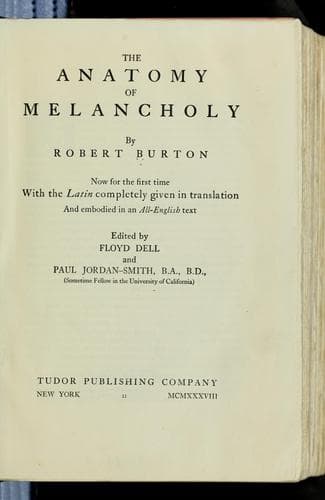
note of the late George Steevens, Esq., in his copy of_ THE ANATOMY OF
MELANCHOLY.
DEMOCRITUS JUNIOR AD LIBRUM SUUM.
Vade liber, qualis, non ausum dicere, felix,
Te nisi felicem fecerit Alma dies.
Vade tamen quocunque lubet, quascunque per oras,
Et Genium Domini fac imitere tui.
I blandas inter Charites, mystamque saluta
Musarum quemvis, si tibi lector erit.
Rura colas, urbem, subeasve palatia regum,
Submisse, placide, te sine dente geras.
Nobilis, aut si quis te forte inspexerit heros,
Da te morigerum, perlegat usque lubet.
Est quod Nobilitas, est quod desideret heros,
Gratior haec forsan charta placere potest.
Si quis morosus Cato, tetricusque Senator,
Hunc etiam librum forte videre velit,
Sive magistratus, tum te reverenter habeto;
Sed nullus; muscas non capiunt Aquilae.
Non vacat his tempus fugitivum impendere nugis,
Nec tales cupio; par mihi lector erit.
Si matrona gravis casu diverterit istuc,
Illustris domina, aut te Comitissa legat:
Est quod displiceat, placeat quod forsitan illis,
Ingerere his noli te modo, pande tamen.
At si virgo tuas dignabitur inclyta chartas
Tangere, sive schedis haereat illa tuis:
Da modo te facilem, et quaedam folia esse memento
Conveniant oculis quae magis apta suis.
Si generosa ancilla tuos aut alma puella
Visura est ludos, annue, pande lubens.
Dic utinam nunc ipse meus [6](nam diligit istas)
In praesens esset conspiciendus herus.
Ignotus notusve mihi de gente togata
Sive aget in ludis, pulpita sive colet,
Sive in Lycaeo, et nugas evolverit istas,
Si quasdam mendas viderit inspiciens,
Public-domain text, read in full here on John Shaqi.
Reviews
Reviews
No reviews yet
Be the first to share your thoughts on this work.
Join the Discussion
Join the discussion
Sign in to leave a comment or review.
Sign InorCreate an account