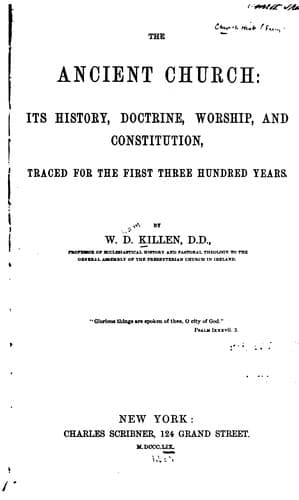
The Ancient Church: Its History, Doctrine, Worship, and ConstitutionKillen, W. D. (William Dool)
Religion
The Ancient Church: Its History, Doctrine, Worship, and Constitution
Killen, W. D. (William Dool)
Church history -- Primitive and early church, ca. 30-600
It has often been asserted that, during His own ministry, our Saviour
encouraged His disciples to violate the Sabbath, and thus prepared the
way for its abolition. But this theory is as destitute of foundation as
it is dangerous to morality. Even the ceremonial law continued to be
binding until Jesus expired upon the cross; and meanwhile He no doubt
felt it to be His duty to attend to every jot and tittle of its
appointments. [211:3] Thus, it became Him "to fulfil all righteousness."
[211:4] He is at pains to shew that the acts of which the Pharisees
complained as breaches of the Sabbath could be vindicated by Old
Testament authority; [211:5] and that these formalists "condemned _the
guiltless,"_ [211:6] when they denounced the disciples as doing that
which was unlawful. Jesus never transgressed either the letter or the
spirit of any commandment pertaining to the holy rest; but superstition
had added to the written law a multitude of minute observances; and
every Israelite was at perfect liberty to neglect any or all of these
frivolous regulations.
The Great Teacher never intimated that the Sabbath was a ceremonial
ordinance which was to cease with the Mosaic ritual. It was instituted
when our first parents were in Paradise; [211:7] and the precept
enjoining its remembrance, being a portion of the Decalogue, [212:1] is
of perpetual obligation. Hence, instead of regarding it as a merely
Jewish institution, Christ declares that it "was made for MAN," [212:2]
or, in other words, that it was designed for the benefit of the whole
human family. Instead of anticipating its extinction along with the
ceremonial law, He speaks of its existence after the downfal of
Jerusalem. When He announces the calamities connected with the ruin of
the holy city, He instructs His followers to pray that the urgency of
the catastrophe may not deprive them of the comfort of the ordinances of
the sacred rest. "Pray ye," said he, "that your flight be not in the
winter, _neither on the Sabbath-day_." [212:3] And the prophet Isaiah,
when describing the ingathering of the Gentiles and the glory of the
Church in the times of the gospel, mentions the keeping of the Sabbath
as characteristic of the children of God. "The sons of the stranger,"
says he, "that join themselves to the Lord to serve him, and to love the
name of the Lord, to be his servants, every one _that keepeth the
Sabbath from polluting it,_ and taketh hold of my covenant--even them I
will I bring to my holy mountain, and make them joyful in my house of
prayer; their burnt-offerings and their sacrifices shall be accepted
upon mine altar: [212:4] for mine house shall be called an house of
prayer _for all people._" [212:5]
Public-domain text, read in full here on John Shaqi.
Reviews
Reviews
No reviews yet
Be the first to share your thoughts on this work.
Elsewhere in the archive
Join the Discussion
Join the discussion
Sign in to leave a comment or review.
Sign InorCreate an account