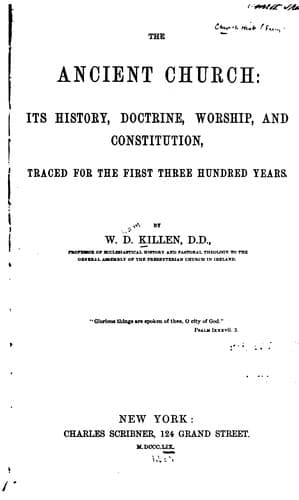
The Ancient Church: Its History, Doctrine, Worship, and ConstitutionKillen, W. D. (William Dool)
Religion
The Ancient Church: Its History, Doctrine, Worship, and Constitution
Killen, W. D. (William Dool)
Church history -- Primitive and early church, ca. 30-600
But when Jesus declared that "the Son of Man is Lord also of the
Sabbath," [212:6] He unquestionably asserted His right to alter the
circumstantials of its observance. He accordingly abolished its
ceremonial worship, gave it a new name, and changed the day of its
celebration. He signalised the first day of the week by then appearing
once and again to His disciples after His resurrection, [212:7] and by
that Pentecostal outpouring of the Spirit [213:1] which marks the
commencement of a new era in the history of redemption. As the Lord's
day was consecrated to the Lord's service, [213:2] the disciples did not
now neglect the assembling of themselves together; [213:3] and the
apostle commanded them at this holy season to set apart a portion of
their gains for religious purposes. [213:4] It was most fitting that the
first day of the week should be thus distinguished under the new
economy; for the deliverance of the Church is a more illustrious
achievement than the formation of the world; [213:5] and as the primeval
Sabbath commemorated the rest of the Creator, the Christian Sabbath
reminds us of the completion of the work of the Redeemer. "There
remaineth, therefore, the keeping of a Sabbath [213:6] to the people of
God, for he that is entered into his rest, he also hath ceased from his
own works, as God did from his." [213:7]
As many of the converts from Judaism urged the circumcision of their
Gentile brethren, they were likewise disposed to insist on their
observance of the Hebrew festivals. The apostles, at least for a
considerable time, did not deem it expedient positively to forbid the
keeping of such days; but they required that, in matters of this nature,
every one should be left to his own discretion. "One man," says Paul,
"esteemeth one day above another; another esteemeth every day alike. Let
every man be fully persuaded in his own mind." [213:8] It is obvious
that the Lord's day is not included in this compromise; for from the
morning of the resurrection there appears to have been no dispute as to
its claims, and its very title attests the general recognition of its
authority. The apostle can refer only to days which were typical and
ceremonial. Hence he says elsewhere--"Let no man judge you in meat, or
in drink, or in respect of an holyday, or of the new moon, or of the
Sabbath days--_which are a shadow of things to come, but the body is of
Christ_." [214:1]
Public-domain text, read in full here on John Shaqi.
Reviews
Reviews
No reviews yet
Be the first to share your thoughts on this work.
Elsewhere in the archive
Join the Discussion
Join the discussion
Sign in to leave a comment or review.
Sign InorCreate an account