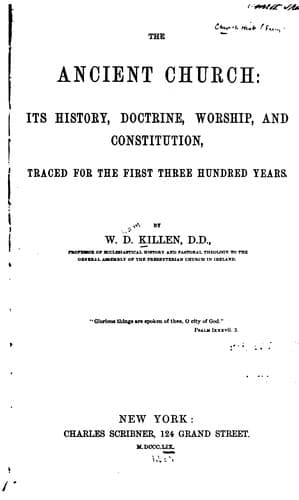
The Ancient Church: Its History, Doctrine, Worship, and ConstitutionKillen, W. D. (William Dool)
Religion
The Ancient Church: Its History, Doctrine, Worship, and Constitution
Killen, W. D. (William Dool)
Church history -- Primitive and early church, ca. 30-600
Very early in the second century the power of the State was turned
against the gospel. About A.D. 107, the far-famed Ignatius, the pastor
of Antioch, is said to have suffered martyrdom. Soon afterwards our
attention is directed to the unhappy condition of the Church by a
correspondence between the celebrated Pliny, and the Emperor Trajan. It
would seem that in Bithynia, of which Pliny was governor, the new faith
was rapidly spreading; and that those who derived their subsistence from
the maintenance of superstition, had taken the alarm. The proconsul had,
therefore, been importuned to commence a persecution; and as existing
statutes supplied him with no very definite instructions respecting the
method of procedure, he deemed it necessary to seek directions from his
Imperial master. He stated, at the same time, the course which he had
hitherto pursued. If individuals arraigned before his judgment-seat, and
accused of Christianity, refused to repudiate the obnoxious creed, they
were condemned to death; but if they abjured the gospel, they were
permitted to escape unscathed. Trajan approved of this policy, and it
now became the law of the Empire.
In his letter to his sovereign [289:1] Pliny has given a very favourable
account of the Christian morality, and has virtually admitted that the
new religion was admirably fitted to promote the good of the community,
he mentions that the members of the Church were bound by solemn
obligations to abstain from theft, robbery, and adultery; to keep their
promises, and to avoid every form of wickedness. When such was their
acknowledged character, it may appear extraordinary that a sagacious
prince and a magistrate of highly cultivated mind concurred in thinking
that they should be treated with extreme rigour. We have here, however,
a striking example of the military spirit of Roman legislation. The laws
of the Empire made no proper provision for the rights of conscience; and
they were based throughout upon the principle that implicit obedience is
the first duty of a subject. Neither Pliny nor Trajan could understand
why a Christian should not renounce his creed at the bidding of the
civil governor. In their estimation, "inflexible obstinacy" in
confessing the Saviour was a crime which deserved no less a penalty than
death.
Public-domain text, read in full here on John Shaqi.
Reviews
Reviews
No reviews yet
Be the first to share your thoughts on this work.
Elsewhere in the archive
Join the Discussion
Join the discussion
Sign in to leave a comment or review.
Sign InorCreate an account