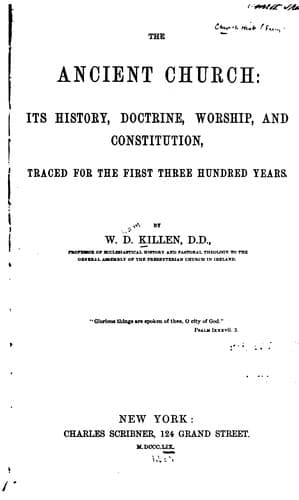
The Ancient Church: Its History, Doctrine, Worship, and ConstitutionKillen, W. D. (William Dool)
Religion
The Ancient Church: Its History, Doctrine, Worship, and Constitution
Killen, W. D. (William Dool)
Church history -- Primitive and early church, ca. 30-600
But Christianity, like the sun, shines on the evil and the good; and
opportunities occurred for shewing that its charities were not confined
within the limits of its own denomination. There were occasions on which
its very enemies could not well refuse to admit its excellence; for in
seasons of public distress, its adherents often signalised themselves as
by far the most energetic, benevolent, and useful citizens. At such
times its genial philanthropy appeared to singular advantage when
contrasted with the cold and selfish spirit of polytheism. Thus, in the
reign of the Emperor Gallus, when a pestilence spread dismay throughout
North Africa, [327:1] and when the pagans shamefully deserted their
nearest relatives in the hour of their extremity, the Christians stepped
forward, and ministered to the wants of the sick and dying without
distinction. [327:2] Some years afterwards, when the plague appeared in
Alexandria, and when the Gentile inhabitants left the dead unburied and
cast out the dying into the streets, the disciples vied with each other
in their efforts to alleviate the general suffering. [327:3] The most
worthless men can scarcely forget acts of kindness performed under such
circumstances. Forty years afterwards, when the Church in the capital of
Egypt was overtaken by the Diocletian persecution, their pagan
neighbours concealed the Christians in their houses, and submitted to
fines and imprisonment rather than betray the refugees. [328:1]
The fact that the heathen were now ready to shelter the persecuted
members of the Church is itself of importance as a sign of the times.
When the disciples first began to rise into notice in the great towns,
they were commonly regarded with aversion; and, when the citizens were
assembled in thousands at the national spectacles, no cry was more
vociferously repeated than that of "The Christians to the lions." But
this bigoted and intolerant spirit was fast passing away; and when the
state now set on foot a persecution, it could not reckon so extensively
on the support of popular antipathy. The Church had attained such a
position that the calumnies once repeated to its prejudice could no
longer obtain credence; the superior excellence of its system of morals
was visible to all; and it could point on every side to proofs of the
blessings it communicated. It could demonstrate, by a reference to its
history, that it produced kind masters and dutiful servants,
affectionate parents and obedient children, faithful friends and
benevolent citizens. On all classes, whether rich or poor, learned or
unlearned, its effects were beneficial. It elevated the character of the
working classes, it vastly improved the position of the wife, it
comforted the afflicted, and it taught even senators wisdom. Its
doctrines, whether preached to the half-naked Picts or the polished
Athenians, to the fierce tribes of Germany or the literary coteries of
Alexandria, exerted the same holy and happy influence. It promulgated a
Public-domain text, read in full here on John Shaqi.
Reviews
Reviews
No reviews yet
Be the first to share your thoughts on this work.
Elsewhere in the archive
Join the Discussion
Join the discussion
Sign in to leave a comment or review.
Sign InorCreate an account