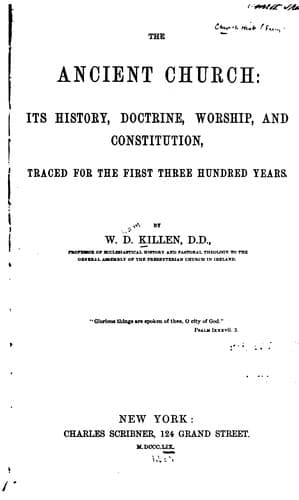
The Ancient Church: Its History, Doctrine, Worship, and ConstitutionKillen, W. D. (William Dool)
Religion
The Ancient Church: Its History, Doctrine, Worship, and Constitution
Killen, W. D. (William Dool)
Church history -- Primitive and early church, ca. 30-600
At this time the jurisdiction of Victor did not properly extend beyond
the few ministers and congregations to be found in the imperial city. A
quarter of a century afterwards even the bishop of Portus, a seaport
town at the mouth of the Tiber about fifteen miles distant from the
capital, acknowledged no allegiance to the Roman prelate. [340:3] The
boldness of Victor in pronouncing so many foreign brethren unworthy of
Catholic communion may at first, therefore, appear unaccountable. But it
is probable that he acted, in this instance, in conjunction with many
other pastors. Among the Churches of Gentile origin there was a deep
prejudice against what was considered the judaizing of the Asiatic
Christians in relation to the Paschal festival, and a strong impression
that the character of the Church was compromised by any very marked
diversity in its religious observances. There is, however, little reason
to doubt that Victor was to some extent prompted by motives of a
different complexion. Fifty years before, the remarkable words addressed
to the apostle of the circumcision--"Thou art Peter, and upon this Rock
I will build my Church" [341:1]--were interpreted at Rome in the way in
which they are now understood commonly by Protestants; for the brother
of the Roman bishop Pius, [341:2] writing about A.D. 150, teaches that
the Rock on which the Church is built is the Son of God; [341:3] but
ingenuity was already beginning to discover another exposition, and the
growing importance of the Roman bishopric suggested the startling
thought that the Church was built on Peter! [341:4] The name of the
Galilean fisherman was already connected with the see of Victor; and it
was thus easy for ambition or flattery to draw the inference that Victor
himself was in some way the heir and representative of the great
apostle. The doctrine that the bishop was necessary as the centre of
Catholic unity had already gained currency; and if a centre of unity for
the whole Church was also indispensable, who had a better claim to the
pre-eminence than the successor of Peter? When Victor fulminated his
sentence of excommunication against the Asiatic Christians he probably
acted under the partial inspiration of this novel theory. He made an
abortive attempt to speak in the name of the whole Church--to assert a
position as the representative or president of all the bishops of the
Catholic world [342:1]--and to carry out a new system of ecclesiastical
unity. The experiment was a failure, simply because the idea looming in
the imagination of the Roman bishop had not yet obtained full possession
of the mind of Christendom.
Public-domain text, read in full here on John Shaqi.
Reviews
Reviews
No reviews yet
Be the first to share your thoughts on this work.
Elsewhere in the archive
Join the Discussion
Join the discussion
Sign in to leave a comment or review.
Sign InorCreate an account