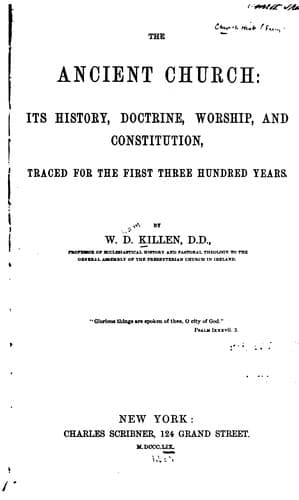
The Ancient Church: Its History, Doctrine, Worship, and ConstitutionKillen, W. D. (William Dool)
Religion
The Ancient Church: Its History, Doctrine, Worship, and Constitution
Killen, W. D. (William Dool)
Church history -- Primitive and early church, ca. 30-600
On doctrinal points his statements are not always consistent, so that it
is extremely difficult to form anything like a correct idea of his
theological sentiments. Thus, on the subject of the Trinity, he
sometimes speaks most distinctly in the language of orthodoxy, whilst
again he employs phraseology which rather savours of the creed of
Sabellius or of Arius. In his attempts to reconcile the gospel and his
philosophy, he miserably compromised some of the most important truths
of Scripture. The fall of man seems to be not unfrequently repudiated in
his religious system; and yet, occasionally, it is distinctly
recognized. [380:1] He maintained the pre-existence of human souls; he
held that the stars are animated beings; he taught that all men shall
ultimately attain happiness; and he believed that the devils themselves
shall eventually be saved. [380:2] It is abundantly clear that Origen
was a man of true piety. His whole life illustrates his self-denial, his
single-mindedness, his delight in the Word of God, and his zeal for the
advancement of the kingdom of Christ. In the Decian persecution he
suffered nobly as a confessor; and the torture which he then endured
seems to have hastened his demise. But with all his learning he was
obviously deficient in practical sagacity; and though both his genius
and his eloquence were of a high order, he possessed scarcely even an
average share of prudence and common sense. His writings diffused, not
the genial light of the Sun of Righteousness, but the mist and darkness
of a Platonized Christianity. Though he induced many philosophers to
become members of the Church, the value of these accessions was greatly
deteriorated by the daring spirit of speculation which they were still
encouraged to cultivate. Of his Christian courage, his industry, and his
invincible perseverance, there can be no doubt. He closed a most
laborious career at Tyre, A.D. 254, in the seventieth year of his age.
Public-domain text, read in full here on John Shaqi.
Reviews
Reviews
No reviews yet
Be the first to share your thoughts on this work.
Elsewhere in the archive
Join the Discussion
Join the discussion
Sign in to leave a comment or review.
Sign InorCreate an account