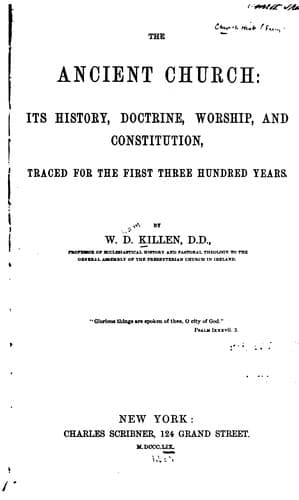
The Ancient Church: Its History, Doctrine, Worship, and ConstitutionKillen, W. D. (William Dool)
Religion
The Ancient Church: Its History, Doctrine, Worship, and Constitution
Killen, W. D. (William Dool)
Church history -- Primitive and early church, ca. 30-600
About the time of the death of Origen, a Latin author, whose writings
are still perused with interest, was beginning to attract much notice.
CYPRIAN of Carthage, before his conversion to Christianity, was a
professor of rhetoric and a gentleman of property. When he renounced
heathenism, he is supposed to have reached the mature age of forty-five
or forty-six; and as he possessed rank, talent, and popular eloquence,
he was deemed no ordinary acquisition to the Church. About two years
after his baptism, the chief pastor of the metropolis of the Proconsular
Africa was removed by death; and Cyprian, by the acclamations of the
Christian people, was called to the vacant office. At that time there
seem to have been only eight presbyters, [381:1] or elders, connected
with the bishopric of Carthage; but the city contained probably some
hundreds of thousands of a population; and, though the episcopal dignity
was not without its perils, it did not want the attractions of wealth
and influence. The advancement of Cyprian gave great offence to the
other elders, who appear to have conceived that one of themselves, on
the ground of greater experience and more lengthened services, had a
better title to promotion. Though the new bishop was sustained by the
enthusiastic support of the multitude, the presbytery contrived,
notwithstanding, to give him considerable annoyance. Five of them,
constituting a majority, formed themselves into a regular opposition;
and for several years the Carthaginian Church was distracted by the
struggles between the bishop and his eldership.
The pastorate of Cyprian extended over a period of about ten years; but
meanwhile persecution raged, and the bishop was obliged to spend nearly
the one-third of his episcopal life in retirement and in exile. From his
retreat he kept up a communication by letters with his flock. [382:1]
The worship and constitution of the Church about the middle of the third
century may be ascertained pretty clearly from the Cyprianic
correspondence. Some of the letters addressed to the Carthaginian
bishop, as well as those dictated by him, are still extant; and as he
maintained an epistolary intercourse with Rome, Cappadocia, and other
places, the documents known as the Cyprianic writings, [382:2] are
amongst the most important of the ancient ecclesiastical memorials. This
eminent pastor has also left behind him several short treatises on
topics which were then attracting public attention. Among these may be
mentioned his tracts on "The Unity of the Church," "The Lord's Prayer,"
"The Vanity of Idols," "The Grace of God," "The Dress of Virgins," and
"The Benefit of Patience."
Public-domain text, read in full here on John Shaqi.
Reviews
Reviews
No reviews yet
Be the first to share your thoughts on this work.
Elsewhere in the archive
Join the Discussion
Join the discussion
Sign in to leave a comment or review.
Sign InorCreate an account