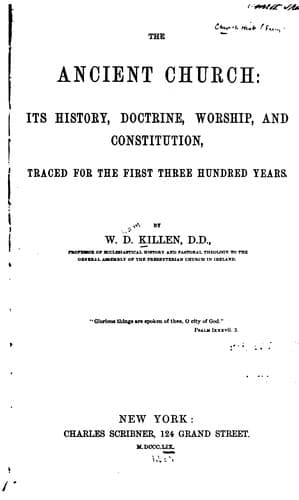
The Ancient Church: Its History, Doctrine, Worship, and ConstitutionKillen, W. D. (William Dool)
Religion
The Ancient Church: Its History, Doctrine, Worship, and Constitution
Killen, W. D. (William Dool)
Church history -- Primitive and early church, ca. 30-600
The writings of Cyprian have long been noted for their orthodoxy; and
yet it must be admitted that his hierarchical prejudices stunted his
charity and obscured his intellectual vision. Tertullian was his
favourite author; and it is evident that he possessed much of the
contracted spirit and of the stiff formalism of the great Carthaginian
presbyter. He speaks in more exalted terms of the authority of bishops
than any preceding writer. It is not improbable that the attempts of his
discontented elders to curb his power inflamed his old aristocratic
hauteur, and thus led to a reaction; and that, supported by the popular
voice, he was tempted absurdly to magnify his office, and to stretch his
prerogative beyond the bounds of its legitimate exercise. His name
carried with it great influence, and from his time episcopal pretensions
advanced apace.
Cyprian was martyred about A.D. 258 in the Valerian persecution. As he
was a man of rank, and perhaps personally related to some of the
imperial officers at Carthage, he seems to have been treated, when a
prisoner, with unusual respect and indulgence. On the evening before his
death an elegant supper was provided for him, and he was permitted to
enjoy the society of a numerous party of his friends. When he reached
the spot where he was to suffer, he was subjected to no lingering
torments; for his head was severed from his body by a single stroke of
the executioner. [383:1]
The only other writer of note who flourished after Cyprian, in the third
century, [383:2] was _Gregory_, surnamed _Thaumaturgus_, or _The
Wonder-Worker_. He belonged to a pagan family of distinction; and, when
a youth, was intended for the profession of the law; but, becoming
acquainted with Origen at Caesarea in Palestine, he was induced to
embrace the Christian faith, and relinquish flattering prospects of
secular promotion. He became subsequently the bishop of Neo-Caesarea in
Pontus. When he entered on his charge he is said to have had a
congregation of only seventeen individuals; but his ministry must have
been singularly successful; for, according to tradition, all the
inhabitants of the city, with seventeen exceptions, were, at the time of
his death, members of the Church. The reports respecting him are
obviously exaggerated, and no credit can be attached to the narrative of
his miracles. [384:1] He wrote several works, of which his "Panegyric on
Origen," and his "Paraphrase on Ecclesiastes," are still extant. The
genuineness of some other tracts ascribed to him may be fairly
challenged.
Public-domain text, read in full here on John Shaqi.
Reviews
Reviews
No reviews yet
Be the first to share your thoughts on this work.
Elsewhere in the archive
Join the Discussion
Join the discussion
Sign in to leave a comment or review.
Sign InorCreate an account