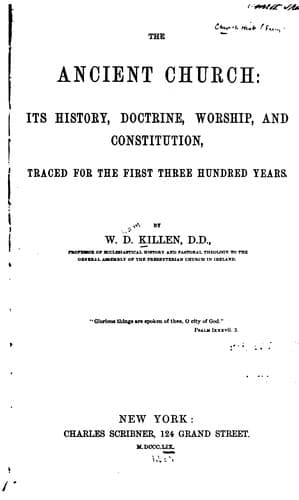
The Ancient Church: Its History, Doctrine, Worship, and ConstitutionKillen, W. D. (William Dool)
Religion
The Ancient Church: Its History, Doctrine, Worship, and Constitution
Killen, W. D. (William Dool)
Church history -- Primitive and early church, ca. 30-600
Though the Jews, as a nation, were now sunk in sensuality or
superstition, there were still some among them, such as Simeon and Anna,
noticed in the Gospel of Luke, [10:3] who were taught of God, and who
exhibited a spirit of vital piety. "The law of the Lord is perfect
converting the soul," and as the books of the Old Testament were
committed to the keeping of the posterity of Abraham, there were "hidden
ones" here and there who discovered the way to heaven by the perusal of
these "lively oracles." We have reason to believe that the Jews were
faithful conservators of the inspired volume, as Christ uniformly takes
for granted the accuracy of their "Scriptures." [11:1] It is an
important fact that they did not admit into their canon the writings now
known under the designation of the _Apocrypha_. [11:2] Nearly three
hundred years before the appearance of our Lord, the Old Testament had
been translated into the Greek language, and thus, at this period, the
educated portion of the population of the Roman Empire had all an
opportunity of becoming acquainted with the religion of the chosen
people. The Jews were now scattered over the earth, and as they erected
synagogues in the cities where they settled, the Gentile world had ample
means of information in reference to their faith and worship.
Whilst the dispersion of the Jews disseminated a knowledge of their
religion, it likewise suggested the approaching dissolution of the
Mosaic economy, as it was apparent that their present circumstances
absolutely required another ritual. It could not be expected that
individuals dwelling in distant countries could meet three times in the
year at Jerusalem to celebrate the great festivals. The Israelites
themselves had a presentiment of coming changes, and anxiously awaited
the appearance of a Messiah. They were actuated by an extraordinary zeal
for proselytism, [11:3] and though their scrupulous adherence to a stern
code of ceremonies often exposed them to much obloquy, they succeeded,
notwithstanding, in making many converts in most of the places where they
resided. [12:1] A prominent article of their creed was adopted in a
quarter where their theology otherwise found no favour, for the Unity of
the Great First Cause was now distinctly acknowledged in the schools of
the philosophers. [12:2]
Public-domain text, read in full here on John Shaqi.
Reviews
Reviews
No reviews yet
Be the first to share your thoughts on this work.
Join the Discussion
Join the discussion
Sign in to leave a comment or review.
Sign InorCreate an account