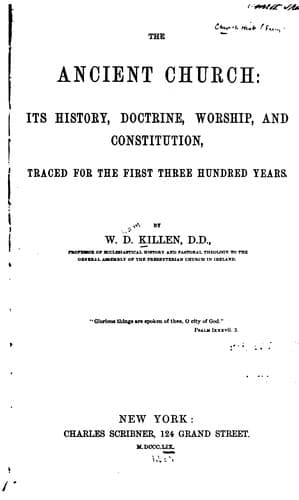
The Ancient Church: Its History, Doctrine, Worship, and ConstitutionKillen, W. D. (William Dool)
Religion
The Ancient Church: Its History, Doctrine, Worship, and Constitution
Killen, W. D. (William Dool)
Church history -- Primitive and early church, ca. 30-600
From the preceding statements we may sec the peculiar significance of
the announcement that God sent forth His Son into the world "_when the
fulness of the time was come_." [12:3] Various predictions [12:4]
pointed out this age as the period of the Messiah's Advent, and
Gentiles, as well as Jews, seem by some means to have caught up the
expectation that an extraordinary personage was now about to appear on
the theatre of human existence. [12:5] Providence had obviously prepared
the way for the labours of a religious reformer. The civil wars which
had convulsed the state were now almost forgotten, and though the
hostile movements of the Germans, and other barbarous tribes on the
confines of the empire, occasionally created uneasiness or alarm, the
public mind was generally unoccupied by any great topic of absorbing
interest. In the populous cities the multitude languished for
excitement, and sought to dissipate the time in the forum, the circus,
or the amphitheatre. At such a crisis the heralds of the most gracious
message that ever greeted the ears of men might hope for a patient
hearing. Even the consolidation of so many nations under one government
tended to "the furtherance of the gospel," for the gigantic roads, which
radiated from Rome to the distant regions of the east and of the west,
facilitated intercourse; and the messengers of the Prince of Peace could
travel from country to country without suspicion and without passports.
And well might the Son of God be called "The desire of all nations."
[13:1] Though the wisest of the pagan sages could not have described the
renovation which the human family required, and though, when the
Redeemer actually appeared, He was despised and rejected of men, there
was, withal, a wide spread conviction that a Saviour was required, and
there was a longing for deliverance from the evils which oppressed
society. The ancient superstitions were rapidly losing their hold on the
affection and confidence of the people, and whilst the light of
philosophy was sufficient to discover the absurdities of the prevailing
polytheism, it failed to reveal any more excellent way of purity and
comfort. The ordinances of Judaism, which were "waxing old" and "ready
to vanish away," were types which were still unfulfilled; and though
they pointed out the path to glory, they required an interpreter to
expound their import. This Great Teacher now appeared. He was born in
very humble circumstances, and yet He was the heir of an empire beyond
comparison more illustrious than that of the Caesars. "There was given
him dominion, and glory, and a kingdom, that all people, nations, and
languages, should serve him; his dominion is an everlasting dominion,
which shall not pass away, and his kingdom that which shall not be
destroyed." [13:2]
CHAPTER II.
THE LIFE OF CHRIST.
Public-domain text, read in full here on John Shaqi.
Reviews
Reviews
No reviews yet
Be the first to share your thoughts on this work.
Join the Discussion
Join the discussion
Sign in to leave a comment or review.
Sign InorCreate an account