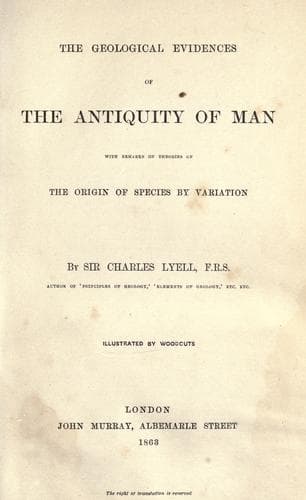
Evolution (Biology); Glacial epoch; Human beings -- Origin; Human evolution
Taking for granted then that the depression was more rapid in the more
elevated region, the great rivers would lose century after century some
portion of their velocity or carrying power, and would leave behind them
on their alluvial plains more and more of the moraine-mud with which
they were charged, till at length, in the course of thousands or some
tens of thousands of years, a large part of the main valleys would
begin to resemble the plains of Egypt where nothing but mud is deposited
during the flood season. The thickness of loam containing shells of land
and amphibious mollusca might in this way accumulate to any extent, so
that the waters might overflow some of the heights originally bounding
the valley and deposits of "platform mud," as it has been termed in
France, might be extensively formed. At length, whenever a re-elevation
of the Alps at the time of the second extension of the glaciers took
place, there would be renewed denudation and removal of such loess; and
if, as some geologists believe, there has been more than one oscillation
of level in the Alps since the commencement of the glacial period, the
changes would be proportionally more complicated and terraces of gravel
covered with loess might be formed at different heights and at different
periods.
HIMALAYAN MUD OF THE GANGES COMPARED TO EUROPEAN LOESS.
Some of the revolutions in physical geography above suggested for the
continent of Europe during the Pleistocene epoch, may have had their
counterparts in India in the Recent Period. The vast plains of Bengal
are overspread with Himalayan mud, which as we ascend the Ganges extends
inland for 1200 miles from the sea, continuing very homogeneous on the
whole, though becoming more sandy as it nears the hills. They who sail
down the river during a season of inundation see nothing but a sheet of
water in every direction, except here and there where the tops of trees
emerge above its level. To what depth the mud extends is not known, but
it resembles the loess in being generally devoid of stratification, and
of shells, though containing occasionally land shells in abundance, as
well as calcareous concretions, called kunkur, which may be compared to
the nodules of carbonate of lime sometimes observed to form layers in
the Rhenish loess. I am told by Colonel Strachey and Dr. Hooker that
above Calcutta, in the Hooghly, when the flood subsides, the Gangetic
mud may be seen in river cliffs 80 feet high, in which they were unable
to detect organic remains, a remark which I found to hold equally in
regard to the Recent mud of the Mississippi.
Public-domain text, read in full here on John Shaqi.
Reviews
Reviews
No reviews yet
Be the first to share your thoughts on this work.
Elsewhere in the archive
Join the Discussion
Join the discussion
Sign in to leave a comment or review.
Sign InorCreate an account