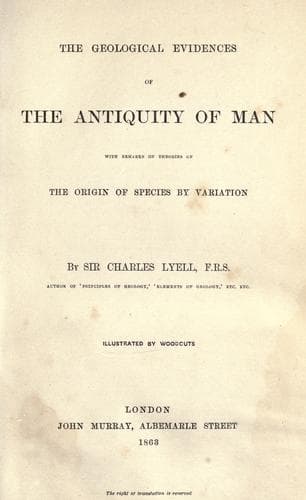
Evolution (Biology); Glacial epoch; Human beings -- Origin; Human evolution
Dr. Wallich, while confirming these observations, informs me that at
certain points in Bengal, farther inland, he met with land-shells in the
banks of the great river. Borings have been made at Calcutta, beginning
not many feet above the sea-level, to the depth of 300 and 400 feet; and
wherever organic remains were found in the strata pierced through they
were of a fluviatile or terrestrial character, implying that during a
long and gradual subsidence of the country the sediment thrown down
by the Ganges and Brahmaputra had accumulated at a sufficient rate to
prevent the sea from invading that region.
At the bottom of the borings, after passing through much fine loam, beds
of pebbles, sand, and boulders were reached, such as might belong to an
ancient river channel; and the bones of a crocodile and the shell of
a freshwater tortoise were met with at the depth of 400 feet from the
surface. No pebbles are now brought down within a great distance of
this point, so that the country must once have had a totally different
character and may have had its valleys, hills, and rivers, before all
was reduced to one common level by the accumulation upon it of fine
Himalayan mud. If the latter were removed during a gradual re-elevation
of the country, many old hydrographical basins might reappear, and
portions of the loam might alone remain in terraces on the flanks of
hills, or on platforms, attesting the vast extent in ancient times
of the muddy envelope. A similar succession of events has, in all
likelihood, occurred in Europe during the deposition and denudation of
the loess of the Pleistocene period, which, as we have seen in a former
chapter, was long enough to allow of the gradual development of almost
any amount of such physical changes.
HUMAN REMAINS IN THE LOESS NEAR STRASBURG.
M. Ami Boue, well known by his numerous works on geology and a
well-practised observer in every branch of the science, disinterred in
the year 1823 with his own hands many bones of a human skeleton from
ancient undisturbed loess at Lahr, nearly opposite Strasburg, on the
right side of the great valley of the Rhine. No skull was detected, but
the tibia, fibula, and several other bones were obtained in a good state
of preservation and shown at the time to Cuvier, who pronounced them to
be human.
HUMAN REMAINS IN LOESS NEAR MAESTRICHT.
Public-domain text, read in full here on John Shaqi.
Reviews
Reviews
No reviews yet
Be the first to share your thoughts on this work.
Elsewhere in the archive
Join the Discussion
Join the discussion
Sign in to leave a comment or review.
Sign InorCreate an account