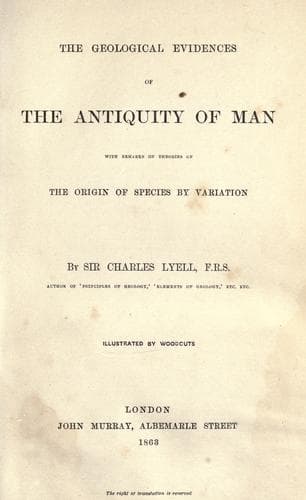
Evolution (Biology); Glacial epoch; Human beings -- Origin; Human evolution
The banks of the Meuse at Maestricht, like those of the Rhine at Bonn
and Cologne, are slightly elevated above the level of the alluvial
plain. On the right bank of the Meuse, opposite Maestricht, the
difference of level is so marked that a bridge with many arches has been
constructed to keep up, during the flood season, a communication between
the higher parts of the alluvial plain and the hills or bluffs which
bound it. This plain is composed of modern loess, undistinguishable in
mineral character from that of higher antiquity, before alluded to,
and entirely without signs of successive deposition and devoid
of terrestrial or fluviatile shells. It is extensively worked for
brick-earth to the depth of about 8 feet. The bluffs before alluded to
often consist of a terrace of gravel, from 30 to 40 feet in thickness,
covered by an older loess, which is continuous as we ascend the valley
to Liege. In the suburbs of that city patches of loess are seen at the
height of 200 feet above the level of the Meuse. The table-land in that
region, composed of Carboniferous and Devonian rocks, is about 450 feet
high, and is not overspread with loess.
A terrace of gravel covered with loess has been mentioned as existing
on the right bank of the Meuse at Maestricht. Answering to it another
is also seen on the left bank below that city, and a promontory of
it projecting into the alluvial plain of the Meuse and approaching
to within a hundred yards of the river, was cut through during the
excavation of a canal running from Maestricht to Hocht, between the
years 1815 and 1823. This section occurs at the village of Smeermass,
and is about 60 feet deep, the lower 40 feet consisting of stratified
gravel and the upper of 20 feet of loess. The number of molars, tusks,
and bones (probably parts of entire skeletons) of elephants obtained
during these diggings, was extraordinary. Not a few of them are still
preserved in the museums of Maestricht and Leyden, together with some
horns of deer, bones of the ox-tribe and other mammalia, and a human
lower jaw, with teeth. According to Professor Crahay, who published an
account of it at the time, this jaw, which is now preserved at Leyden,
was found at the depth of 19 feet from the surface, where the loess
joins the underlying gravel, in a stratum of sandy loam resting on
gravel and overlaid by some pebbly and sandy beds. The stratum is said
to have been intact and undisturbed, but the human jaw was isolated,
the nearest tusk of an elephant being six yards removed from it in
horizontal distance.
Most of the other mammalian bones were found; like these human remains,
in or near the gravel, but some of the tusks and teeth of elephants were
met with much nearer the surface. I visited the site of these fossils in
1860 in company with M. van Binkhorst, and we found the description of
the ground, published by the late Professor Crahay of Louvain, to be
very correct.*
Public-domain text, read in full here on John Shaqi.
Reviews
Reviews
No reviews yet
Be the first to share your thoughts on this work.
Elsewhere in the archive
Join the Discussion
Join the discussion
Sign in to leave a comment or review.
Sign InorCreate an account