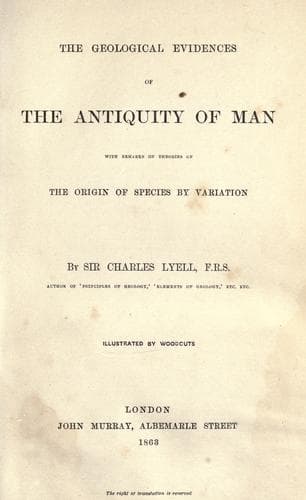
Evolution (Biology); Glacial epoch; Human beings -- Origin; Human evolution
In the actual state of the globe, the isothermal lines, or lines of
equal winter temperature when traced westward from Europe to North
America bend 10 degrees south, there being a marked excess of winter
cold in corresponding latitudes west of the Atlantic. During the glacial
period, viewing it as a whole, we behold signs of a precisely similar
deflection of these same isothermal lines when followed from east to
west; so that if, in the hope of accounting for the former severity of
glacial action in Europe, we suppose the absence of the Gulf Stream and
imagine a current of equivalent magnitude to have flowed due north from
the Gulf of Mexico, we introduce, as we have just hinted, a source
of heat into precisely that part of the continent where the extreme
conditions of refrigeration are most manifest. Viewed in this light, the
hypothesis in question would render the glacial phenomena described in
the present chapter more perplexing and anomalous than ever. But here
another question arises, whether the eras at which the maximum of
cold was attained on the opposite sides of the Atlantic were really
contemporaneous? We have now discovered not only that the glacial period
was of vast duration, but that it passed through various phases and
oscillations of temperature; so that, although the chief polishing and
furrowing of the rocks and transportation of erratics in Europe and
North America may have taken place contemporaneously, according to the
ordinary language of geology, or when the same testacea and the
same Pleistocene assemblage of mammalia flourished, yet the extreme
development of cold on the opposite sides of the ocean may not have been
strictly simultaneous, but on the contrary the one may have preceded or
followed the other by a thousand or more than a thousand centuries.
Public-domain text, read in full here on John Shaqi.
Reviews
Reviews
No reviews yet
Be the first to share your thoughts on this work.
Elsewhere in the archive
Join the Discussion
Join the discussion
Sign in to leave a comment or review.
Sign InorCreate an account