The Arab conquests in Central AsiaGibb, H. A. R. (Hamilton Alexander Rosskeen)
Islamic
The Arab conquests in Central Asia
Gibb, H. A. R. (Hamilton Alexander Rosskeen)
Bukhoro (Uzbekistan) -- History; Islamic Empire; Khanate of Bukhara -- History
Transcriber’s Note: This text makes use of an uncommon system for
transcription of Arabic. Italics, sometimes on a _s_ingle le_t_ter,
are semantically meaningful; and you’ll need a font that can display
macrons (āēīōū) and the characters for the transliterations of
Arabic letters ain (ʿ) and hamza (ʾ).
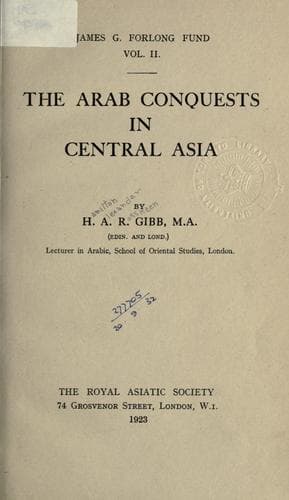
THE ARAB CONQUESTS IN CENTRAL ASIA
JAMES G. FORLONG FUND
VOL. II.
THE ARAB CONQUESTS
IN
CENTRAL ASIA
H. A. R. GIBB, M.A.
(EDIN. AND LOND.)
Lecturer in Arabic, School of Oriental Studies, London.
THE ROYAL ASIATIC SOCIETY
74 GROSVENOR STREET, LONDON, W.1.
1923
CONTENTS
PAGE
PREFACE vii
I. THE OXUS BASIN
Early History—Political Divisions—The
Arabic Sources 1
II. THE EARLY RAIDS 15
III. THE CONQUESTS OF QUTAYBA 29
IV. THE TURKISH COUNTERSTROKE 59
V. THE RECONQUEST OF TRANSOXANIA 88
BIBLIOGRAPHY OF CHIEF WORKS CITED 100
PREFACE
The first draft of this work was presented to the University of London in
December 1921, under the title of “The Arab Conquest of Transoxania”, as
a thesis for the degree of Master of Arts, and was approved by the Senate
in January 1922, for publication as such. During the year my attention
was taken up in other directions and, except for the publication of two
studies on the subject in the Bulletin of the School of Oriental Studies,
nothing further was done until by the generosity of the Trustees of the
Forlong Bequest Fund an opportunity of publication was offered. In its
present form the work has been largely rewritten and revised. It makes no
claim to present a complete historical account of the Arabs in Central
Asia, but is intended solely as a critical study of the authorities in
greater detail than has hitherto been made. Much is therefore omitted
because it has already been dealt with in the standard histories. In
order to keep down the cost of publication, the extensive references
which originally accompanied the text have been cut down to a few notes
at the end of each chapter. No references are given when, as in the great
majority of cases, the authority for the statements made can easily be
found in the appropriate place either in _T_abarī or Balādhurī.
Public-domain text, read in full here on John Shaqi.
Reviews
Reviews
No reviews yet
Be the first to share your thoughts on this work.
Join the Discussion
Join the discussion
Sign in to leave a comment or review.
Sign InorCreate an account