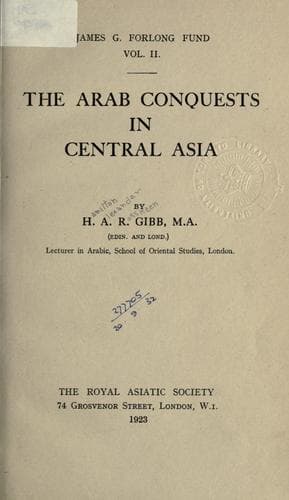
The Arab conquests in Central AsiaGibb, H. A. R. (Hamilton Alexander Rosskeen)
Islamic
The Arab conquests in Central Asia
Gibb, H. A. R. (Hamilton Alexander Rosskeen)
Bukhoro (Uzbekistan) -- History; Islamic Empire; Khanate of Bukhara -- History
I regret that several works which are indispensable for a thorough study
of the subject have, for linguistic reasons, been inaccessible to me.
Such are van Vloten’s _Opkomst der Abbasiden_, and almost the whole range
of Russian research work. Through the kindness of Sir Denison Ross,
however, I have been able to avail myself of a draft MS. translation of
the most important and valuable of them all, Professor W. Barthold’s
_Turkestan_, as well as of his as yet unpublished London lectures on
“The Nomads of Central Asia.” My sincere thanks are due to Sir Denison
Ross also for his continued interest and material assistance ever
since he first introduced me to the subject; to Sir Thomas Arnold for
much encouragement and helpful counsel; to Professor Barthold, who has
read the MS. through and made a number of valuable suggestions; to the
Trustees of the Forlong Bequest Fund for their kindness in undertaking
the publication; and in no small measure to my wife, who has given much
time and labour to preparing the MS. for publication.
London, April, 1923.
I. INTRODUCTION
THE OXUS BASIN
_Early History._
The Oxus is a boundary of tradition rather than of history. Lying
midway between the old frontier of Aryan civilisation formed by the
Jaxartes and the Pamīr and the natural strategic frontier offered by the
north-eastern escarpment of the plateau of Īrān, it has never proved a
barrier to imperial armies from either side. It was not on the Oxus but
on the Jaxartes that Alexander’s strategic insight fixed the position of
Alexander Eschate, and when the outposts of Persian dominion were thrust
back by the constant pressure of the Central Asian hordes, their retreat
was stayed not on the Oxus but on the Murghāb. Thus when the tide of
conquest turned and the Arabs won back her ancient heritage for Persia,
they, like Alexander, were compelled to carry their arms ever further to
the East and all unknowing re-establish the frontiers of the Achaemenid
Empire. It was from the legends of Sāsānian times, enshrined in the pages
of the historians and the national epic of Firdawsī, that the Oxus came
to be regarded as the boundary between Īrān and Tūrān.
Through all the centuries of invasion, however, the peoples of Sogdiana
and the Oxus basin remained Iranian at bottom, preserving an Iranian
speech and Iranian institutions. But the political conditions of the
country at the period of the Arab conquests were so complex that it is
necessary to trace briefly the course of their development.
Public-domain text, read in full here on John Shaqi.
Reviews
Reviews
No reviews yet
Be the first to share your thoughts on this work.
Join the Discussion
Join the discussion
Sign in to leave a comment or review.
Sign InorCreate an account