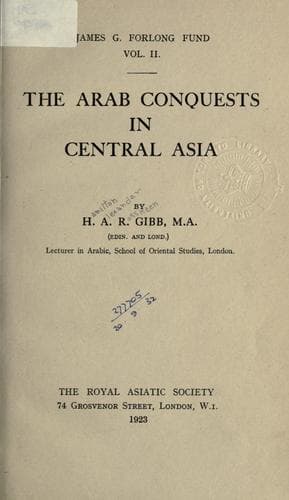
The Arab conquests in Central AsiaGibb, H. A. R. (Hamilton Alexander Rosskeen)
Islamic
The Arab conquests in Central Asia
Gibb, H. A. R. (Hamilton Alexander Rosskeen)
Bukhoro (Uzbekistan) -- History; Islamic Empire; Khanate of Bukhara -- History
first of these was the proud national spirit of the Iranians which was
eventually to break down the supremacy of the Arabs and give birth to
the first Persian dynasties in Islām. The few wise governors of Khurāsān
found in this their strongest support, but, outraged again and again by
an arrogant and rapacious administration, the subject peoples became
embittered and sought all means of escape from its tyranny. The second
was the interest of the commercial relations on which the wealth and
prosperity of the country depended. This again might have disposed the
cities to accept a rule which promised not only stability, but a wide
extension of opportunity. The Arab governors, as we shall see, were
not indeed blind to this, but the exactions of the treasury, and still
more the greed of local officials, combined with the unsettlement of
constant invasion to create an attitude of distrust, which deepened later
into despair. It must not be forgotten that the commercial ties of the
Sogdians were much stronger with the East than with the West, and that
this too prompted them to cultivate relations with the Turks and Chinese
rather than with the Arabs when the necessity of making a choice was
forced upon them.
_The Arabic Sources._
The early Arabic sources are remarkably rich in material for the
reconstruction of the conquests in Khurāsān and Transoxania. For the
earlier period the narratives of Yaʿqūbī and Balādhurī are nearly as full
as those of _T_abarī, but the special value of the latter lies in his
method of compilation which renders the traditions amenable to critical
study and thus provides a control for all the others. Moreover, while
the other historians, regarding the conquests of Qutayba as definitely
completing the reduction of Transoxania, provide only meagre notices for
the later period, _T_abarī more than compensates for their silence by
the enormous wealth of detail embodied in the accounts he quotes from
Al-Madāʾinī and others of the last thirty years of Umayyad rule. As a
general rule, these three historians rely on different authorities,
though all use the earlier histories of Al-Madāʾinī and Abū ʿUbayda
to some extent. The monograph of Narshakhī (d. 959 A.D.) based on
both Arabic and local sources, with some resemblance to Balādhurī, is
unfortunately preserved only in a Persian version of two centuries
later which has obviously been edited, to what extent is unknown, but
which probably represents the original as unsatisfactorily as Balʿamī’s
Persian version of _T_abarī. Even so it preserves to us some account of
the peoples against whom the Arab invaders were matched, and thus does a
little to remedy the defects of the other historians in this respect. It
may well be doubted, however, whether some of its narratives merit the
reliance placed upon them by van Vloten[17]. The much later historian Ibn
al-Athīr introduces very little new material, but confines himself for
Public-domain text, read in full here on John Shaqi.
Reviews
Reviews
No reviews yet
Be the first to share your thoughts on this work.
Join the Discussion
Join the discussion
Sign in to leave a comment or review.
Sign InorCreate an account