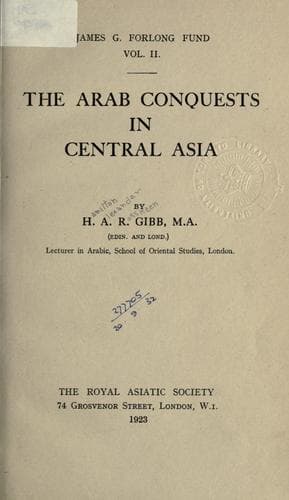
The Arab conquests in Central AsiaGibb, H. A. R. (Hamilton Alexander Rosskeen)
Islamic
The Arab conquests in Central Asia
Gibb, H. A. R. (Hamilton Alexander Rosskeen)
Bukhoro (Uzbekistan) -- History; Islamic Empire; Khanate of Bukhara -- History
the most part to abridging and re-editing the narratives in _T_abarī,
with a tendency to follow the more exaggerated accounts. The geographer
Ibn Khūrdādhbih gives a list of titles and names, which is, however, too
confused to supply any reliable evidence.
Reference has already been made to certain aspects of the conquests
in which the Arab historians are misleading. Their information on the
Turks and the principalities of Sogdiana can now, fortunately, be
supplemented and parts of their narratives controlled from Chinese
sources, chiefly through Chavannes’ valuable “Documents sur les Tou-Kiue
(Turcs) Occidentaux.” But there are two other facts which also demand
attention: one, that the Arabic authorities, as we possess them, and
even with all allowance made for their limitations, are by no means
exhaustive; _i.e._, reliance on omissions in the narratives is an unsafe
principle of criticism: the other, that by critical study it is possible
to distinguish at certain points several lines of tendentious tradition
or legend, directed to the interests of national feeling or of some
particular tribe or faction, and centred in some cases round specific
persons. These may most conveniently be summarised as follows:
1. A Qaysite tradition, centred on the family of Ibn Khāzim:
2. An Azd-Rabīʿa tradition, centred on Muhallab and hostile
to _H_ajjāj. This became the most popular tradition among the
Arabs, and is followed by Balādhurī, but opposed by Yaʿqūbī:
3. A Bāhilite tradition, centred on the tribal hero, Qutayba b.
Muslim. In general it found little favour but is occasionally
quoted somewhat sarcastically by _T_abarī.
4. A local Bukhārā tradition, followed by Yaʿqūbī, Balādhurī
and Narshakhī. It presents the early conquests under the form
of an historical romance, centred on the Queen Khātūn in the
part of a national Boadicea. Other local traditions, which are
frequently utilised by _T_abarī, seem to be much more free from
serious exaggeration:
5. The few notices in Dīnawarī follow an entirely divergent and
extremely garbled tradition from unknown sources, which may for
the most part be neglected:
6. The quotations made by Balādhurī (_e.g._ 422. 10) from Abū
ʿUbayda show the influence of a rewriting of episodes with an
anti-Arab bias, directed to the interests of the Shuʿūbīya
movement, in which Abū ʿUbayda was a prominent figure[18].
7. In the later period, there appears also the fragments of a
tradition of which Nasr b. Sayyār is the hero.
Public-domain text, read in full here on John Shaqi.
Reviews
Reviews
No reviews yet
Be the first to share your thoughts on this work.
Join the Discussion
Join the discussion
Sign in to leave a comment or review.
Sign InorCreate an account