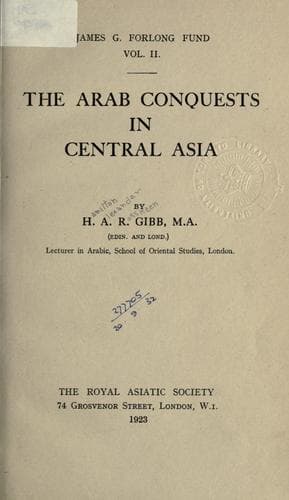
The Arab conquests in Central AsiaGibb, H. A. R. (Hamilton Alexander Rosskeen)
Islamic
The Arab conquests in Central Asia
Gibb, H. A. R. (Hamilton Alexander Rosskeen)
Bukhoro (Uzbekistan) -- History; Islamic Empire; Khanate of Bukhara -- History
Arab legend relates that the Muslim forces, pursuing Yazdigird from the
field of Nihāwand in 21/642, had already come in contact with the “Turks”
of _T_ukhāristān before the death of ʿOmar. But the final destruction
of the Sāsānid power and first imposition of Arab rule on Khurāsān only
followed ten years later, by the troops of ʿAbdullah ibn ʿĀmir, ʿOthmān’s
governor in Ba_s_ra. The Ephthalites of Herāt and Bādghīs submitted
without a blow, and the first serious check to their advance was met in
the Murghāb valley, when al-A_h_naf b. Qays with an army of 4,000 Arabs
and 1,000 Persians found himself opposed by the organised forces of
Lower _T_ukhāristān and was compelled to retire on Merv-Rūdh. A second
expedition under al-Aqraʿ b. _H_ābis, however, defeated a weaker force in
Jūzjān, and subsequently occupied Jūzjān, Fāryāb, _T_ālaqān, and Balkh.
Small divisions made plundering raids into the neighbouring territories,
_e.g._, to Siminjān (a town within the frontiers of _T_ukhāristān proper,
governed by a Turkish prince, the Ruʿb Khān), and to Khwārizm, not always
with success; on the other hand, a successful raid was made on Māyamurgh
in Sogdiana in 33/654, which is mentioned by Abū ʿUbayda alone of the
Arabic authorities[21]. A general insurrection which broke out shortly
afterwards, headed by a certain Qārin, apparently a member of the noble
Persian family bearing that name, seems to have been instrumental in
causing the Arabs to evacuate Khurāsān for a time[22], though several
raids are recorded of ʿAlī’s governors between 35 and 38 A.H. These
earliest “conquests,” in fact, were little more than plundering raids on
a large scale, the effect of that movement of expansion whose momentum
was carrying forward the Arabs irresistibly. According to the Chinese
records, which, however, require to be used with caution at this
point, the retreat of the Arabs in 655 was followed up by the army of
_T_ukhāristān who reinstated Pērōz, the son of Yazdigird, as titular king
of Persia[23].
Public-domain text, read in full here on John Shaqi.
Reviews
Reviews
No reviews yet
Be the first to share your thoughts on this work.
Join the Discussion
Join the discussion
Sign in to leave a comment or review.
Sign InorCreate an account