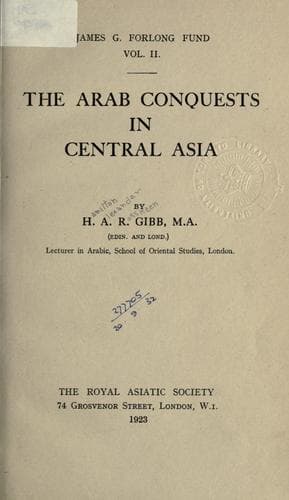
The Arab conquests in Central AsiaGibb, H. A. R. (Hamilton Alexander Rosskeen)
Islamic
The Arab conquests in Central Asia
Gibb, H. A. R. (Hamilton Alexander Rosskeen)
Bukhoro (Uzbekistan) -- History; Islamic Empire; Khanate of Bukhara -- History
Some, if not all, of these traditions developed in some detail, and
where they are not balanced by other versions they present a distorted
narrative of events, verging in some cases on the fictitious. The most
noteworthy examples of this are the Khātūn legend (see below p. 18) and
the typical story of the exploits of Mūsā b. Khāzim in Transoxania in a
style not unworthy of Bedouin romance[19]. It is therefore most important
to disentangle these variant traditions and assign its proper value to
each. The Bāhilite accounts of Qutayba’s conquests, for instance, contain
wild exaggerations of fact, which, nevertheless, have sometimes been
utilised in all seriousness by modern historians, amongst other purposes
to establish synchronisms with the Turkish inscriptions[20].
With these precautions, it is possible to follow up and reconstruct, with
comparative certainty and completeness, that progress of the Arab arms
in Central Asia whose vicissitudes are outlined in the following pages.
NOTES
(Full Titles in Bibliography)
[1] Franke, Beiträge 41 ff., 67. Cordier, Chine I, 225.
[2] If Marquart’s identification (Ērānshahr, 201 f.) is correct.
[3] Cordier I. 229: Ērānshahr 50 ff.
[4] Yuan Chwang I. 103. Prof. Barthold suggests that the connection
between the Ephthalites and the Huns may have been political only, not
racial.
[5] Chavannes, Documents 155: Ērānshahr 89.
[6] _T_ab. I. 2885. 13 and 2886. 3: Yaʿqūbī, History, II, 193: Yāqūt
(ed. Wüstenfeld) I. 492: Balādhurī 403: Ērānshahr 65 f., 77 f., and
150. Bādghīs was still a nomad pasture-ground in the XIVth century: Ibn
Ba_tt_ū_t_a, III, 67 f.
[7] Yuan Chwang I. 105; II. 266; Chav. Doc. 161: Ērānshahr 250 ff.
[8] Tomaschek, Soghdiana, 170.
[9] See Marquart, Chronologie, 71: Shiratori in Keleti Szemle III (1902)
footnote to pp. 122-3.
[10] _Cf._ Narshakhī 29. 4. On the Iranisation of nomadic elements,
Blochet, Introduction à l’Histoire des Mongols, (Leyden, 1910) p. 211
note; Peisker, The Asiatic Background, pp. 353-6.
[11] Chavannes, Notes 91, and _cf._ below p. 80.
[12] _Cf._ Barthold, in Zeitschrift für Assyriologie XXVI (1911) p. 262.
[13] Yuan Chwang I, 75 n. 2, 102 ff: II 270: Chav. Doc. 200 f.
[14] _E.g._ _T_ab. II, 1448, 7-10: _cf._ Ērānshahr 228.
[15] _Cf._ Yaʿqūbī, Geog. 287: _T_ab. II 1205. 12: Ērānshahr 66, 87 ff.
[16] Chavannes, Doc. 201, Note 37.
[17] Narshakhī’s unreliability is even more marked in his account of the
origins of the Sāmānid dynasty: _cf._ Barthold, Turkestan 215 n. 3.
[18] See Goldziher, Muhammadanische Studien, I, 195 ff.
[19] Prof. Barthold has drawn my attention to the fact that the story of
Mūsā also includes (twice over) an episode from the popular legend of
Zopyrus. See his article in Zapiski XVII (1906) 0141, and Wellhausen,
Arabische Reich, 257, 265.
[20] _E.g._ Marquart, Chronologie, p. 8.
II. THE EARLY RAIDS
_The Conquest of Lower _T_ukhāristān._
Public-domain text, read in full here on John Shaqi.
Reviews
Reviews
No reviews yet
Be the first to share your thoughts on this work.
Join the Discussion
Join the discussion
Sign in to leave a comment or review.
Sign InorCreate an account