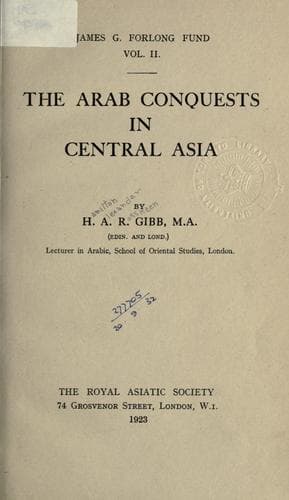
The Arab conquests in Central AsiaGibb, H. A. R. (Hamilton Alexander Rosskeen)
Islamic
The Arab conquests in Central Asia
Gibb, H. A. R. (Hamilton Alexander Rosskeen)
Bukhoro (Uzbekistan) -- History; Islamic Empire; Khanate of Bukhara -- History
Although at this junction Ziyād himself died, his policy was carried on
by his sons, in particular by ʿUbaydullah. Scarcely any governor, not
even _H_ajjāj, has suffered so much at the hands of the traditionists
as the “Murderer of _H_usayn,” though his ability and devotion to the
Umayyads are beyond question. It is not surprising therefore that his
earlier military successes should be so briefly related, in spite of
their importance. Yet as he was no more than 25 years of age when
appointed by Muʿāwiya to the province of Khurāsān on probation, and only
two years later was selected to fill his father’s position in ʿIrāq, his
administration must have been markedly successful. The policy of Ziyād
had now firmly secured Khurāsān and made it feasible to use it as a base
for the extension of the conquests into the rich lands across the river.
On his arrival at Merv, therefore, in the autumn of 53/673, the new
governor began preparations for an invasion of Bukhārā.
The Shao-wu principality of Bukhārā was at this time second in importance
only to Samarqand. It included not only the greater part of the oasis
(“al-Bukhārīya”) then much more thickly populated than now, but also
the great emporium of Paykand, which controlled the trade route across
the Oxus at Āmul. Of its early history we have two accounts, both
confused, inaccurate in detail, and often conflicting. From these it
may be gathered that the prince, who held the high Turkish title of
Shād[25], resided at Paykand, the citadel of Bukhārā being either founded
or restored by the Bukhār Khudāh Bidūn, probably in consequence of the
Arab invasions. This prince at his death left a son only a few months
old on whose behalf the regency was exercised by the Queen-Mother. This
princess, known under the title of Khātūn (a Turkish form of the Sogdian
word for “lady”) became the central figure in the local traditions,
which represent the Arab invasions as occurring precisely during the
period of her regency. This version is the one accepted by Balādhurī,
Yaʿqūbī, and Narshakhī, but though not altogether devoid of historical
value, it is certainly misplaced, and the true account of the early
conquests must, for cogent reasons, be sought in the brief and widely
divergent narratives of _T_abarī. In the first place the Khātūn-legend,
like all such legends, has grown by natural elaboration of detail,
as in the account given by Narshakhī of Khātūn’s administration of
justice and by continual accretions from other streams of tradition, as
seen, on comparing the narratives of Balādhurī and Narshakhī, in the
introduction of episodes of Ibn Khāzim and Muhallab. Critical examination
also reveals alternative traditions and chronological inconsistencies,
as, for example, the birth of _T_ughshāda after the invasion of Saʿīd
b. ʿOthmān, Khātūn’s reign of 15 years, and others mentioned below.
There is clear evidence of the late compilation of the tradition in the
Public-domain text, read in full here on John Shaqi.
Reviews
Reviews
No reviews yet
Be the first to share your thoughts on this work.
Join the Discussion
Join the discussion
Sign in to leave a comment or review.
Sign InorCreate an account