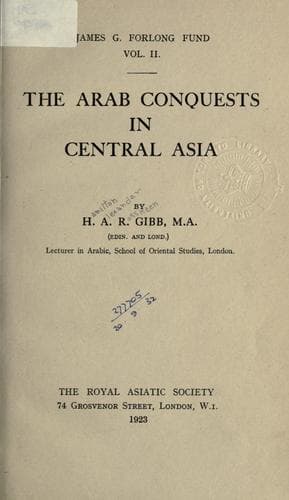
The Arab conquests in Central AsiaGibb, H. A. R. (Hamilton Alexander Rosskeen)
Islamic
The Arab conquests in Central Asia
Gibb, H. A. R. (Hamilton Alexander Rosskeen)
Bukhoro (Uzbekistan) -- History; Islamic Empire; Khanate of Bukhara -- History
frequent references to “_T_arkhūn, King of _S_ughd,” though his reign
did not begin until considerably after 696[26]. It may be noticed that
in the variant account of the conquests prefixed to the Persian edition
of Narshakhī and ascribed to An-Naysābūrī there is no reference at all
to Khātūn. Moreover there are indications that _T_abarī was aware of the
local tradition and completely rejected it; this, at least, would account
for the unusual practice of specifying Qabaj-Khātūn as “the wife of the
king” in 54 A.H. Even Balādhurī rejects the more fantastic developments
of the legend. _T_abarī’s narratives, however, require to be collated
with the additional material in Balādhurī, who has not relied entirely
on the local tradition. The germ of the native version is probably to be
found in a confusion of the Arab conquests with the later war between
Bukhārā and Wardāna[27], whose echoes are heard in Qutayba’s invasions
thirty years after.
In the spring of 54/674 ʿUbaydullah b. Ziyād crossed the river and
marched directly on Paykand. After a partial success, he led his forces
forward towards Bukhārā and severely defeated the army of the Bukhār
Khudāh. From _T_abarī’s narrative, which relates only that two thousand
men of Bukhārā, skilful archers, were taken by ʿUbaydullah to Ba_s_ra,
where they formed his personal guard, it is left to be inferred that a
treaty was concluded under which the Bukhār Khudāh became tributary. The
local tradition magnifies the expedition by adding a siege of Bukhārā
(during the winter) and bringing in an army of Turks to assist Khātūn,
but confirms the success of the Arabs. ʿUbaydullah’s practice on this
occasion of forming a bodyguard or retinue of captives appears to have
been a common one. ʿAbdur-Ra_h_mān ibn Samura had previously brought
captives from Sijistān to Ba_s_ra, where they built him a mosque, and
later governors of Khurāsān continued the practice, as will be seen. In
this may be recognised perhaps the germ of the Turkish guards recruited
by the later ʿAbbāsid Caliphs.
Public-domain text, read in full here on John Shaqi.
Reviews
Reviews
No reviews yet
Be the first to share your thoughts on this work.
Join the Discussion
Join the discussion
Sign in to leave a comment or review.
Sign InorCreate an account