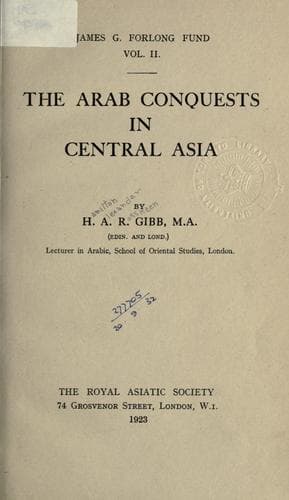
The Arab conquests in Central AsiaGibb, H. A. R. (Hamilton Alexander Rosskeen)
Islamic
The Arab conquests in Central Asia
Gibb, H. A. R. (Hamilton Alexander Rosskeen)
Bukhoro (Uzbekistan) -- History; Islamic Empire; Khanate of Bukhara -- History
Saʿīd was unable to retain his position in Khurāsān, and for five
years the conquests were stayed (except for summer raids) under the
indolent Aslam b. Zurʿa and the avaricious ʿAbdur-Ra_h_mān b. Ziyād.
In 61/680-681 Yazīd I appointed Salm, another son of Ziyād, to Khurāsān
and Sijistān. Eager to emulate his brother, Salm, even before leaving
Ba_s_ra, announced his intention of renewing the expeditions into
Transoxania and enlisted a picked force on the spot, including such
tried leaders as Muhallab b. Abī _S_ufra and ʿAbdullah b. Khāzim. From
a poem preserved in the _H_amāsa of Abū Tammām[30] it would appear
that somewhat unwilling levies for this expedition were raised even in
Mesopotamia. Towards the close of the winter a surprise attack was made
on Khwārizm, with some success. _T_abarī gives two versions of this
expedition, the first of which is a highly embroidered one from the
Muhallabite tradition. During the same year, Salm marched into _S_ughd
and occupied Samarqand, where he appears to have made his headquarters
over the winter. Balādhurī mentions a subsidiary raid on Khujanda under
Aʿshā Hamdān, in which, however, the Muslims were defeated, and a
_S_ughdian revolt which was crushed with the loss of its leader, here
called Bandūn. The name is almost certainly to be read as that of the
Bukhār-Khudāh, Bīdūn[31], and in view of the silence of _T_abarī raises
rather a difficult problem. It may be conjectured that what Balādhurī
intended was a revolt of the Bukhariots, combined with _S_ughdian forces.
The origin of this statement may perhaps be sought for in the Bukhārā
tradition, which Balādhurī does not follow in his general account of the
expeditions of Salm, but which he may have tried to work in with the
other. On the other hand he nowhere refers to Bīdūn as the Bukhār Khudāh.
As related by Narshakhī and Yaʿqūbī Salm’s expedition is directed solely
against Bukhārā. Khātūn, on promising her hand to _T_arkhūn, receives a
reinforcement of 120,000 men from _S_ughd, and Bīdūn (here still alive)
recruits an army in “Turkistān,” including the “Prince of Khotan.” After
severe fighting, the Muslim forces, numbering 6,000, kill Bīdūn and rout
the unbelievers, taking so much booty that the share of each horseman
amounts to 2,400 dirhems. Khātūn, thoroughly humbled by this decisive
proof of Arab invincibility, sues for peace and pays a heavy tribute.
Beyond the fantastic exaggerations and incoherencies of the legend, there
is nothing inherently improbable in a Bukhariot revolt. In support of
this view, it may be remarked that the death of Bīdūn at this point would
agree with the slender data we have for the internal wars which probably
formed the original basis of the Khātūn-legend, and would also provide
a foothold for the later developments of the tradition. Without fuller
evidence, however, we can get no further than reasonable conjecture.
Public-domain text, read in full here on John Shaqi.
Reviews
Reviews
No reviews yet
Be the first to share your thoughts on this work.
Join the Discussion
Join the discussion
Sign in to leave a comment or review.
Sign InorCreate an account