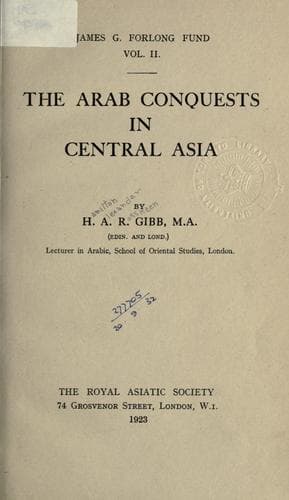
The Arab conquests in Central AsiaGibb, H. A. R. (Hamilton Alexander Rosskeen)
Islamic
The Arab conquests in Central Asia
Gibb, H. A. R. (Hamilton Alexander Rosskeen)
Bukhoro (Uzbekistan) -- History; Islamic Empire; Khanate of Bukhara -- History
After the conquests made by Salm, which probably occupied the years 682
and 683, it seemed as though the Arabs were on the verge of imposing
their rule on Transoxania when civil war broke out in the heart of the
Empire. Even allowing for the fact that these expeditions were little
more than raids, the comparative ease with which the Arabs held to ransom
the richest cities in the country is astonishing. The explanation can
lie only in their mutual exclusiveness. There is not a hint of united
action in the field in _T_abarī’s accounts[32]. A factor which may have
exercised some influence was that Sogdiana was completely isolated during
these years and unable to look for support from without. The power of
the Western Turks was broken by the Chinese armies between 645 and 658;
Chinese forces are said to have reached as far west as Kish, and the
Emperor Kao-Tsung had officially annexed all the territories formerly
included in the Turkish dominions. In the latter year the provinces of
Sogdiana and the Jaxartes were organized in sixteen districts, including
a “Government of Persia” under the Pērōz already mentioned, situated
apparently in Sijistān, possibly even in Eastern Khurāsān[33]. The
immediate practical effect of this change of status was of little moment,
but her nominal annexation gave China a prestige which was destined to
exercise immense influence in determining the attitude of the peoples
of Sogdiana to the Arabs. From 670 to 692, however, the new power of
Tibet held the Chinese armies in check in the Tarim basin and cut off
all possibility of Chinese intervention in the West. The Sogdian princes
were thus thrown on their own resources, and, ignorant as yet of the
danger behind the Arab raids, they seem to have bowed to the storm. It
must not be forgotten that the cities had never before met such an enemy
as the Arabs. They had been accustomed to plundering raids by Turks, who
disappeared as quickly as they came, and who, disliking to undertake
a lengthy siege, were easily appeased by a ransom. Familiar with such
nominal annexations, they would naturally adopt the same tactics against
the new invaders. Had the Arabs maintained their pressure, there was thus
every prospect that Transoxania would have been colonised with a tithe of
the expense and loss incurred in its reconquest and would have become as
integral a part of the Muslim dominions as Khurāsān. But the opportunity
was lost in the fratricidal struggles of the factions, and when the Arabs
recommenced their encroachments, the determined resistance offered to
their advance showed that the lessons of the first invasion had not been
lost on the native princes.
_The Withdrawal of the Arabs._
Public-domain text, read in full here on John Shaqi.
Reviews
Reviews
No reviews yet
Be the first to share your thoughts on this work.
Join the Discussion
Join the discussion
Sign in to leave a comment or review.
Sign InorCreate an account