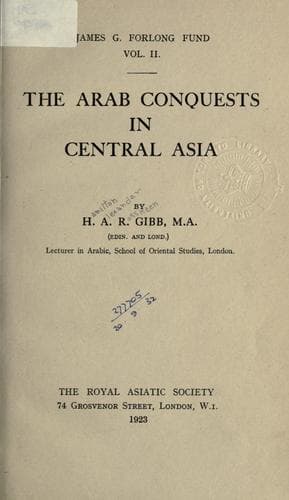
The Arab conquests in Central AsiaGibb, H. A. R. (Hamilton Alexander Rosskeen)
Islamic
The Arab conquests in Central Asia
Gibb, H. A. R. (Hamilton Alexander Rosskeen)
Bukhoro (Uzbekistan) -- History; Islamic Empire; Khanate of Bukhara -- History
The second century B.C. was a period of upheaval in Central Asia: the
powerful Hiung-Nu peoples were dispossessing weaker tribes of their
pasture lands and forcing them to migrate westwards. Between 150 and
125 B.C. a succession of nomadic tribes, the last and most powerful of
which were a branch of the Yueh-Chi, were driven down into Sogdiana. It
is now generally held that these tribes were of Aryan origin, though the
question is not perhaps settled with absolute certainty. Before long,
however, a second group, the K’ang, possessed themselves of Sogdiana,
driving the Yueh Chi on into Bactria and the Afghan mountains[1]. In
these districts they found, alongside the Iranian peasantry, a settled
population of Tukhari (in Chinese, Ta-Hia), already noted in the Chinese
annals for their commercial enterprise[2], and while at first the nomad
tribes introduced complete confusion, it would seem that they rapidly
absorbed, or were absorbed by, the native elements, and thus assimilated
the Hellenistic civilisation of Bactria. From this fusion arose, about
50 A.D., the powerful Kushan Empire which spread into India on the one
side and probably maintained some form of suzerainty over the K’ang
kingdoms of Sogdiana on the other. Under the new empire, Buddhism was
acclimatised in Turkestan, and Sogdiana developed into a great _entrepôt_
for Chinese trade with the West. Towards the close of the third century
the Kushan Empire, weakened by attacks from the new national dynasties
in India and Persia, reverted to its primitive form of small independent
principalities, which, however, retained sufficient cohesion to prevent
a Persian reconquest. It is practically certain that Sāsānian authority
never extended beyond Balkh and rarely as far. In the fourth and
fifth centuries references are made to a fresh horde of nomads in the
north-east, the Juan-Juan (Chionitae, Avars)[3], but it does not appear
that any new settlements were made in the Oxus countries.
In the middle of the fifth century, another people, the Ephthalites
(Arabic Hay_t_al, Chinese Ye-Tha), perhaps a branch of the Hiung-nu,
not only completely overran the former Kushan territories, but by
successive defeats of the Persian armies forced the Sāsānid Kings to pay
tribute. The Ephthalites appear to have been a nomadic people organised
as a military caste of the familiar Turkish type, and the existing
institutions and principalities, in large part at least, continued side
by side with them[4]. Their rule was too transitory to produce any
lasting effects, or to inflict any serious injury on the commerce and
prosperity of Sogdiana.
Public-domain text, read in full here on John Shaqi.
Reviews
Reviews
No reviews yet
Be the first to share your thoughts on this work.
Join the Discussion
Join the discussion
Sign in to leave a comment or review.
Sign InorCreate an account