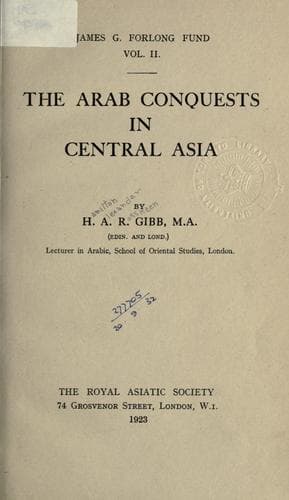
The Arab conquests in Central AsiaGibb, H. A. R. (Hamilton Alexander Rosskeen)
Islamic
The Arab conquests in Central Asia
Gibb, H. A. R. (Hamilton Alexander Rosskeen)
Bukhoro (Uzbekistan) -- History; Islamic Empire; Khanate of Bukhara -- History
The Muhallabite tradition which represents the appointment as distasteful
to _H_ajjāj but popular in Khurāsān is almost certainly influenced
by the later hostility between Yazīd and _H_ajjāj. It is probable,
however, that _H_ajjāj, whose policy was to keep his governors dependent
on himself, viewed with suspicion the concentration of authority in
the hands of the leader of a powerful hostile clan, but he was content
to wait for the meantime and give Yazīd sufficient rope to hang
himself. Except for an attempted raid on Khwārizm Yazīd carried out no
expeditions, while under his government the precarious internal balance
of Khurāsān was soon upset. The quarrels of Qays had been composed by
Muhallab, but they were in no mood to bear with the leadership of the
parvenu Azd; already before the death of Muhallab, in spite of the
Tamīmite eulogy quoted by _T_abarī, there was a moment when the feud
threatened to break out. The pronounced factional leanings of Yazīd
strained the situation still further. Even more serious was the attitude
of the mawālī. _H_urayth, the brother of Thābit ibn Qu_t_ba, had been
left behind at Kish by Muhallab to collect the tribute, but on his return
was scourged for disobedience. The disgrace cut _H_urayth deeply; too
late Muhallab realised the gravity of his act, but _H_urayth spurned his
overtures and with Thābit fled to Mūsā at Tirmidh. Yazīd retaliated with
foolish severity by maltreating their families, which only inflamed the
general resentment. _H_urayth and Thābit used their influence to stir
up an insurrection to act in concert with Mūsā; the king of Chaghāniān
and his Ephthalite confederates headed by Nēzak, prince of Bādghīs,
readily responded, while Persian interest was excited by the return to
_T_ukhāristān of the son of Pērōz, the heir of the Sāsānids. It seems
probable that even some of Qays were a party to the scheme[38]. Seizing
an opportunity when Yazīd was occupied with the rebel forces of Ibn
al-Ashath on the borders of Khurāsān the revolt broke out. Yazīd was
powerless to prevent the expulsion of his residents from Chaghāniān and
Lower _T_ukhāristān, and Mūsā is said to have refrained from invading
Khurāsān only from fear that it would fall into the hands of Thābit and
_H_urayth. Even the success claimed for Yazīd in Bādghīs can have been
of little effect[39]. Fortunately for the Arabs, Mūsā’s jealousy of
Thābit and _H_urayth caused a division in the ranks of their enemies, but
though the brothers both fell in battle, the danger remained acute. The
son of Pērōz still lingered in _T_ukhāristān, and even at Damascus there
was some uneasiness about the situation in Khurāsān[40].
Public-domain text, read in full here on John Shaqi.
Reviews
Reviews
No reviews yet
Be the first to share your thoughts on this work.
Join the Discussion
Join the discussion
Sign in to leave a comment or review.
Sign InorCreate an account