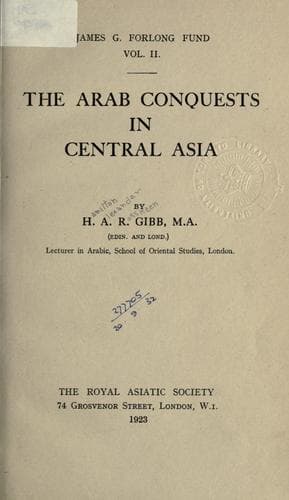
The Arab conquests in Central AsiaGibb, H. A. R. (Hamilton Alexander Rosskeen)
Islamic
The Arab conquests in Central Asia
Gibb, H. A. R. (Hamilton Alexander Rosskeen)
Bukhoro (Uzbekistan) -- History; Islamic Empire; Khanate of Bukhara -- History
To _H_ajjāj it was obvious that the first essential was to reunite
the Arabs and that so long as Yazīd was in power that was impossible.
The only difficulty was to find a governor acceptable to Qays and to
substitute him without risking a revolt of Azd. It was solved with
admirable ingenuity. By ordering Yazīd to transfer his authority to
his weaker brother Mufa_dd_al, _H_ajjāj at one stroke removed the man
from whom he had most to fear and prevented him from uniting Azd in
opposition, although Yazīd realised that the fall of his house was
imminent. At the same time the Caliph’s permission was sought for the
nomination of Qutayba ibn Muslim as governor of Khurāsān. Belonging to
the neutral tribe of Bāhila, Qutayba was reckoned as allied to Qays,
but might be trusted to hold the scales evenly between the factions; he
had already distinguished himself in ʿIrāq and in his governorship of
Rayy, and was the more devoted to _H_ajjāj in that he was protected by
no strong party of his own. The accepted belief that _H_ajjāj took no
steps to remove the family of Muhallab until Mūsā was put out of the way
is based on a remark attributed to Muhallab in the Mūsā-legend, which is
frequently contradicted elsewhere both expressly and by implication.
Mufa_dd_al, during his nine months of office in 85/704, seems to have
endeavoured to impress _H_ajjāj by a show of military activity against
the rebels in Bādghīs. At the same time, acting in concert with the local
princes (magnified in the legend to “_T_arkhūn and as-Sabal”), he sent
an expedition to Tirmidh under ʿOthmān b. Ma_s_ʿūd. Mūsā was cut off and
killed in a sortie and his nephew Sulaymān surrendered at discretion,
_H_ajjāj’s first exclamation on hearing the news is said to have been
one of anger at the insult to Qays, but the last hindrance to the
appointment of the new governor was now removed and towards the close of
the year Qutayba b. Muslim arrived in Merv.
NOTES
[21] Bal. 408. 5: Chav., Doc. 172, n. 1. There were two localities called
Māyamurgh in _S_ughd: one near Samarqand (I_st_akhrī 321. 6), and the
other one day’s march from Nasaf on the Bukhārā road (ibid. 337. 7).
According to the Chinese records the former is the one in question here.
[22] Yāqūt, ed. Wüstenfeld, II. 411. 21: _cf._ Caetani, “Annali” VIII. 4
ff. On Qārin, Nöldeke, Sasaniden 127, 437: Marquart, Ērānshahr 134.
[23] Chav., Doc. 172.
[24] _Cf._ Lammens, “Ziād b. Abīhi” (R.S.O. 1912) p. 664.
[25] _Cf._ with _T_ughshāda the name of the reigning prince in 658,
Chav., Doc. 137.
[26] Chav., Doc. 136.
[27] Narshakhī 8 and 30.
[28] Chronologie 57: Ērānshahr 303 f. This view is supported also by the
letter from the king of Samarqand to the Emperor of China in 718 (see p.
60), which puts the first Arab conquest some 35 years before, _i.e._ in
682 or 683.
[29] Accounts also in Kitāb al-Aghānī I. 18: Ibn Qutayba 101.
[30] _H_amāsa, ed. Freytag, I. 363-4.
[31] _Cf._ Barthold, “Turkestan” 103 n. 1.
Public-domain text, read in full here on John Shaqi.
Reviews
Reviews
No reviews yet
Be the first to share your thoughts on this work.
Join the Discussion
Join the discussion
Sign in to leave a comment or review.
Sign InorCreate an account