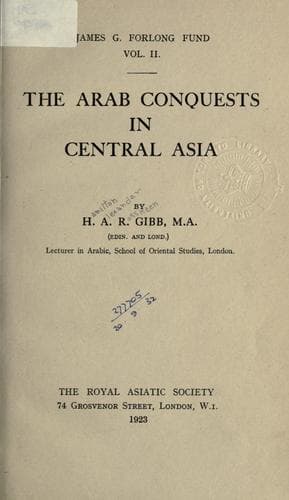
The Arab conquests in Central AsiaGibb, H. A. R. (Hamilton Alexander Rosskeen)
Islamic
The Arab conquests in Central Asia
Gibb, H. A. R. (Hamilton Alexander Rosskeen)
Bukhoro (Uzbekistan) -- History; Islamic Empire; Khanate of Bukhara -- History
conciliatory attitude, therefore, Qutayba earned the confidence of the
Persians and repaid it with confidence; from his constant employment
of Persian agents and his growing preference for Persian governors, it
would seem even that he came to regard them as forming the “ʿAshīra”
he lacked among the Arabs. Although it earned him the ill-will of the
Arabs and played a great part in his fall, it may be that in this he was
instrumental in giving the first impulse to the recovery of a national
sentiment amongst the Persians of Khurāsān.
The situation in Central Asia was also favourable for a renewal of the
attempt to annex to the Arab dominions the rich lands of Transoxania,
though it is doubtful how much information the Arabs possessed on this
point. In 682, while China, weakened internally by the intrigues of the
Empress Wu, had her hands tied by the wars with Tibet, the Eastern or
Northern Turks had re-asserted their independence. The new Empire never
regained its authority over all the western territories of the former
Khans, but by constant campaigns had extended its rule over the Ten
Tribes of the Ili and Chu, who, we are told, were “almost annihilated.”
In 701 the Eastern Turks invaded Sogdiana, but there is no reason to
assume, though it has frequently been suggested, that Muhallab’s forces
at Kish were affected by this raid. As the necessity of securing hostages
for the safety even of the lines of communication shows, the hostility of
the local forces is sufficient to explain all the encounters narrated.
The devastation and loss that invariably accompanied these raids must
have still further weakened the resources of the subject princes, to
whom there was small consolation in the appointment of a son of the Khan
to command the Ten Tribes. In any case the unceasing warfare which the
Eastern Turks had to wage against the Türgesh from 699 to 711 effectually
prevented them from sending assistance in response to any appeals for
support which may have reached them from Sogdiana[41]. Equally if not
more impossible was it for the Türgesh to intervene in Sogdiana during
the same period[42]. By the “Turks,” as we have seen, the Arab historians
mean as a general rule the local inhabitants, amongst whom there may
quite possibly have been included at that time Turkish elements.
Occasional references to the Khāqān (unless they may be taken to refer
to local chiefs, which is improbable) are obvious _fakhr_-developments.
The narrative of 98 A.H. on which the theory of Türgesh intervention is
mainly based, is a pure Bāhilite invention. Finally, the experience of
the Arabs in later years shows us that, if the resistance of Sogdiana had
been backed by large forces of Turks, it would have been impossible for
Qutayba to achieve so large a measure of success.
The conquests of Qutayba fall naturally into four periods:
1. 86/705: The recovery of Lower _T_ukhāristān;
2. From 87/706 to 90/709: The conquest of Bukhārā;
Public-domain text, read in full here on John Shaqi.
Reviews
Reviews
No reviews yet
Be the first to share your thoughts on this work.
Join the Discussion
Join the discussion
Sign in to leave a comment or review.
Sign InorCreate an account