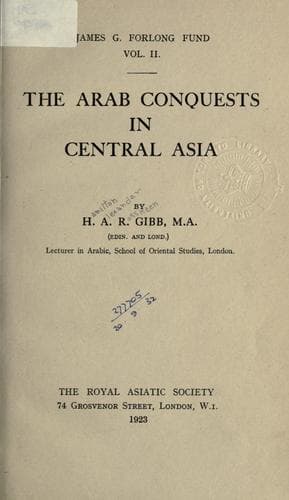
The Arab conquests in Central AsiaGibb, H. A. R. (Hamilton Alexander Rosskeen)
Islamic
The Arab conquests in Central Asia
Gibb, H. A. R. (Hamilton Alexander Rosskeen)
Bukhoro (Uzbekistan) -- History; Islamic Empire; Khanate of Bukhara -- History
In the following year, Qutayba, first making sure of the crossings at
Āmul and Zamm, opened his campaigns in Bukhārā with an attack on Paykand.
From the expressions of Narshakhī, on whose history of this period we
may place more reliance since his details as a rule fit in with and
supplement the other histories, it can be gathered that the principality
of Bukhārā was weakened by civil war and invasion. During the minority of
_T_ughshāda and the regency of Khātūn, the ambitious nobles had struggled
between themselves for the chief power; most of the territories,
including Bukhārā itself, had been seized by the prince of Wardāna
and the remaining districts seem to have been brought under the rule
of Khunuk Khudāh, a noble who assumed the title of Bukhār Khudāh[45].
Paykand was thus more or less isolated and, from Narshakhī’s account,
seems to have been left to its fate. The battle with the _S_ughdians
related in _T_abarī is an obvious anticipation from the events of the
following year. After a siege of some two months the city came to terms
with Qutayba, who left it under a small garrison and, according to
_T_abarī’s version, began the return march to Merv. An émeute in Paykand,
however, brought him back at once. It seems reasonable to assume that
the citizens, imagining Qutayba’s attack to have been no more than an
isolated raid, tried to expel the garrison as soon as he retired. The
details given in Narshakhī, that on Qutayba’s advance towards Bukhārā a
certain citizen, enraged by the insulting conduct of the governor, Warqāʾ
b. Nasr al-Bāhili, attempted to murder him, are trivial and unconvincing.
Whatever the cause of the revolt may have been, however, Qutayba took a
terrible revenge. In accordance with mediaeval practice the renegade city
was sacked, its fighting men put to death, and its women and children
enslaved. The booty taken from this, the first of the great trading
cities of Central Asia to be forcibly captured by the Arabs, furnished
inexhaustible material for the exaggerated details of later tradition.
The most important part of the spoil was an arsenal of weapons and
armour, the excellence of which was such that the “forging of _S_ughd”
appears in contemporary verse alongside the traditional “forging of
David” for superlative craftsmanship[46]. With the consent of _H_ajjāj,
these weapons were not included in the division of the booty but used
to re-equip the army. The statement that there were only 350 suits of
armour in the whole army before this is, however, of Bāhilite provenance
and scarcely worthy of credence. The exemplary punishment thus meted
out by Qutayba to Paykand at the beginning of his career was a stern
warning to Nēzak and the Sogdians. Those who accepted Arab dominion would
be humanely treated, but any attempt at rebellion would be inexorably
crushed. Nevertheless the sentence on Paykand was somewhat mitigated in
the sequel, as Narshakhī adds that the captives were ransomed by the
Public-domain text, read in full here on John Shaqi.
Reviews
Reviews
No reviews yet
Be the first to share your thoughts on this work.
Join the Discussion
Join the discussion
Sign in to leave a comment or review.
Sign InorCreate an account