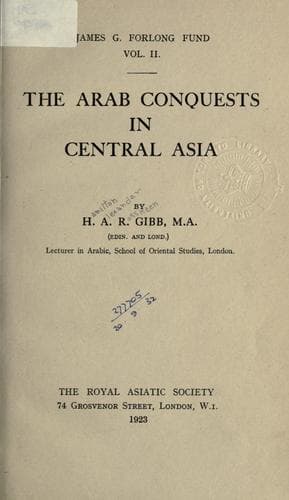
The Arab conquests in Central AsiaGibb, H. A. R. (Hamilton Alexander Rosskeen)
Islamic
The Arab conquests in Central Asia
Gibb, H. A. R. (Hamilton Alexander Rosskeen)
Bukhoro (Uzbekistan) -- History; Islamic Empire; Khanate of Bukhara -- History
merchants of Paykand on their return from the annual trading expedition
to China, and the city, after lying in ruins for many years, was
eventually rebuilt.
The disaster at Paykand roused the princes and merchants of Transoxania
to the danger of neglecting the invaders. The feud between Wardāna and
Bukhārā was patched up; round Wardān Khudāh, the central figure and
organiser of the struggle for independence, gathered the forces of all
the nearer principalities. Thus when Qutayba, on renewing his expedition
in 88/707, had taken the outlying town of Tūmushkath (not Nūmushkath,
which was the earlier name of Bukhārā) and Rāmīthana (or Rāmtīn), he
found his communications cut by the troops of Wardāna, Bukhārā, and
_S_ughd. It is not, perhaps, impossible that the prince of Farghāna
should have cooperated with the _S_ughdians, as stated in Madāʾinī’s
account. On the other hand the Arabic narratives are far from explicit,
and the _S_ughdians here referred to are much more probably those of
Kish than of Samarqand, a suspicion which is confirmed by the famous
punning order of _H_ajjāj: “Crush Kish, destroy Nasaf, and drive Wardān
back.” Narshakhī and Yaʿqūbī give an account of the negotiations between
_H_ayyān an-Naba_t_ī, representing Qutayba, and _T_arkhūn king of
_S_ughd, which is certainly to be put, with _T_abarī, after the conquest
of Bukhārā two years later. Throughout all these campaigns there is
manifest a tendency, common to the early chronicles of all nations,
to exaggerate the numbers and composition of the opposing forces. As
usual the Bāhilite account carries this to the point of absurdity by
introducing a Türgesh force of no less than 200,000 men, an obvious
anachronism, influenced by the later Türgesh invasions. The connection
is made clear by the mention of Kūr Maghānūn, whom we find nearly thirty
years later (_T_ab. II. 1602. 2) as “one of the chiefs of the Türgesh.”
The true account would seem to be that Qutayba did not attempt to fight
a pitched battle, but by dilatory tactics wearied out the allies and
gave time for their natural inclination towards disunion to operate,
then evaded them by a rapid march through the Iron Gate and, except for
a rearguard skirmish with the enemy’s cavalry, got his army clear across
the river at Tirmidh. The appointment of ʿAbdur-Ra_h_mān ibn Muslim
to command the rearguard gives us the clue, as it was to this brother
that Qutayba regularly entrusted all the most difficult commands. In
the following year Qutayba was still unable to make headway against the
united forces of Wardān Khudāh, Kish and Nasaf, and after protracted
fighting (in spite of the double victory claimed by the Bāhilites)
returned to Merv. For this weakness he was severely reprimanded by
_H_ajjāj, who, with the aid of a map, drew up a plan of attack. The
invasion of 90/709 seems to have taken Wardān Khudāh by surprise, as the
Muslim army was able to advance at once to the siege of Bukhārā. There
Public-domain text, read in full here on John Shaqi.
Reviews
Reviews
No reviews yet
Be the first to share your thoughts on this work.
Join the Discussion
Join the discussion
Sign in to leave a comment or review.
Sign InorCreate an account