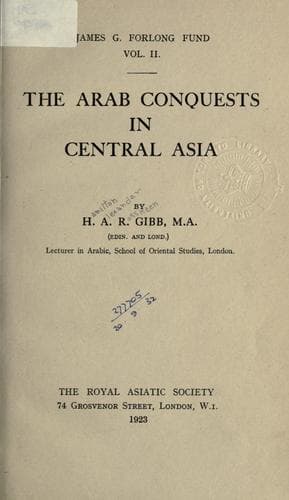
The Arab conquests in Central AsiaGibb, H. A. R. (Hamilton Alexander Rosskeen)
Islamic
The Arab conquests in Central Asia
Gibb, H. A. R. (Hamilton Alexander Rosskeen)
Bukhoro (Uzbekistan) -- History; Islamic Empire; Khanate of Bukhara -- History
Qutayba’s army was already disbanded and the winter was setting in.
All that he could do was to despatch the garrison at Merv, some 12,000
men, under ʿAbdur-Ra_h_mān, with instructions to winter in Balkh,
where they could counter any immediate move by Nēzak, and advance into
_T_ukhāristān in the spring. This resolute action made Qutayba master
of the situation and so intimidated the rebels that when, in the early
spring, the Arabs marched through the disaffected districts, scarcely a
blow was struck and the princes either submitted or fled. The inhabitants
were granted a complete amnesty except at _T_alāqān, concerning which
the traditions are hopelessly confused. According to one account, a band
of robbers were there executed and crucified, but it is possible that
it was selected for special severity because there alone the revolt had
openly broken out[48]. There was probably also some reorganization of the
administration of Lower _T_ukhāristān, in the direction of conferring
fuller powers on the Arab governors installed in each district, though
the native princes continued to exercise a nominal authority. From
Balkh, Qutayba marched forward and rejoined ʿAbdur-Ra_h_mān. With the
assistance of the lesser princes they pursued and captured Nēzak, who was
subsequently executed on direct orders from _H_ajjāj, in violation of
Qutayba’s promise of pardon[49]. How little this action was condemned by
the prevailing spirit of the age, however, is shown by the contemporary
poems quoted by _T_abarī, lauding the “defender of the precincts of
Islam” and comparing his action to the measures formerly adopted against
the Jewish tribes of Madīna. Yet even at this time we find traces of
the new spirit that was to make itself more felt in later years, and
hear voices raised, like Thābit Qu_t_na’s, against the “treachery that
calls itself resolution.” _T_abarī inserts at this point the narrative of
the putting to death of the hostages of Jūzjān, in retaliation for the
murder of the Arab hostage in Jūzjān, a much more excusable incident.
Balādhurī puts it at the beginning of Qutayba’s career, however, as
though it belonged to the first pacification of Lower _T_ukhāristān, so
that its position in _T_abarī may possibly be due to its superficial
similarity with the case of Nēzak. The results of this expedition were
of the greatest importance: not only was Nēzak’s scheme crushed and
Lower _T_ukhāristān henceforth incorporated in the Arab Empire, but also
for the first time Arab authority was extended over the Jabghu and his
immediate vassals in the Oxus basin. The former, exiled to Damascus,
formed a valuable hostage against any attempt to regain independence,
and it seems not improbable that the king of Chaghāniān was made regent
for the young Jabghu (see above, p. 9), ʿAbdur-Ra_h_mān was appointed
governor of Balkh, in order to supervise the administration of the new
province.
Public-domain text, read in full here on John Shaqi.
Reviews
Reviews
No reviews yet
Be the first to share your thoughts on this work.
Join the Discussion
Join the discussion
Sign in to leave a comment or review.
Sign InorCreate an account