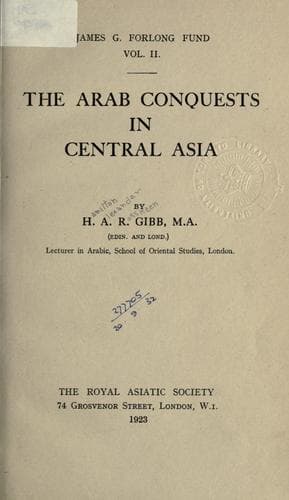
The Arab conquests in Central AsiaGibb, H. A. R. (Hamilton Alexander Rosskeen)
Islamic
The Arab conquests in Central Asia
Gibb, H. A. R. (Hamilton Alexander Rosskeen)
Bukhoro (Uzbekistan) -- History; Islamic Empire; Khanate of Bukhara -- History
Meanwhile a serious situation had arisen in _S_ughd. The merchants and
nobles of Samarqand had resented the weakness of their king and the
payment of tribute: in Qutayba’s absence the party for resistance _à
outrance_ gained the upper hand, and _T_arkhūn, deposed on the ground
of incapacity, committed suicide. The choice of the electors fell on
Ghūrak[55], a prince of whom we would gladly have known more. Under
the ever increasing difficulties with which he was confronted during
his twenty-seven years of rule, his consummate handling of the most
confused situations shows him to have been at once statesman and patriot,
and preserved his kingdom from repeated disaster. The action of the
_S_ughdian nobles, however, the Arabic account of which is confirmed by
the Chinese records, constituted a challenge to Arab pretensions which
Qutayba could not be slow in answering. These considerations clearly
disprove the partial tradition of Abū ʿUbayda (Bal. 422), to the effect
that Qutayba treacherously attacked Khwārizm and Samarqand in spite of
the treaties of Saʿīd ibn ʿOthmān, and the argument based upon it by van
Vloten in _La Domination Arabe_, must also, in consequence, be somewhat
modified.
The winter of 93/711, therefore, was spent in preparations for an
expedition against Samarqand, but before the opening of the campaigning
season, Qutayba received a secret mission from the Khwārizm Shāh, who
offered to become tributary if the Arabs would rid him of his rebellious
brother Khurrazādh. Qutayba agreed, and after publicly announcing his
intention of invading _S_ughd, suddenly appeared at Hazārasp. The
followers of the Khwārizm Shāh were persuaded to offer no resistance
for this year, at least, and accepted the terms, which included, in
accordance with the new scheme, the provision of a corps of 10,000
ablebodied men as well as the usual tribute. Qutayba remained at the
capital[56] until the army was collected, while ʿAbdur-Ra_h_mān was
employed, according to _T_abarī, in reducing the king of Khāmjird, who
from the parallel account in Balādhurī is to be identified either with
Khurrazādh, or at least with his party. The Persian _T_abarī adds a
long and doubtless legendary narrative of his surrender. Four thousand
prisoners were taken and butchered, probably by order of the Khwārizm
Shāh.
Public-domain text, read in full here on John Shaqi.
Reviews
Reviews
No reviews yet
Be the first to share your thoughts on this work.
Join the Discussion
Join the discussion
Sign in to leave a comment or review.
Sign InorCreate an account