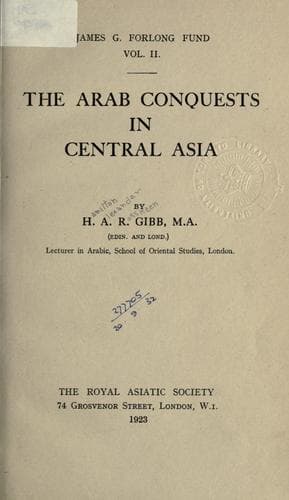
The Arab conquests in Central AsiaGibb, H. A. R. (Hamilton Alexander Rosskeen)
Islamic
The Arab conquests in Central Asia
Gibb, H. A. R. (Hamilton Alexander Rosskeen)
Bukhoro (Uzbekistan) -- History; Islamic Empire; Khanate of Bukhara -- History
The later history of Khwārizm under Qutayba’s rule is an unhappy one.
His first governor Iyās b. ʿAbdullah, proved too weak for his post,
and on Qutayba’s withdrawal the Khwārizmians rose in revolt and put to
death the king who had betrayed them. Iyās was recalled in disgrace,
together with the Persian _H_ayyān an-Naba_t_ī, who had been associated
with him, and Qutayba’s brother ʿAbdullah (in Balādhurī ʿUbaydullah) was
appointed as temporary regent until, after the capture of Samarqand, a
strong force under al-Mughīra b. ʿAbdullah could be sent to effect a
reconquest. Qutayba’s retribution on this occasion exceeded even the
terror of Paykand and Shūmān. We are told by Al-Bīrūnī that the educated
classes and more cultured elements in Khwārizm were slaughtered almost
to extinction. He refers this by implication to the second expedition of
Qutayba (though it does not appear that the governor led the expedition
in person), which is borne out by what we know of Qutayba’s methods in
similar cases, while there is no instance in his career of such an action
on a first conquest. It was in all probability the educated classes
(including no doubt the hierarchy) who led the revolt against the traitor
king and thus met with the severest punishment. The dynasty, however, was
maintained, and it is not improbable that the Arab colony of which we
hear shortly afterwards was settled in Khwārizm at the same time[57].
The booty from the first expedition into Khwārizm was enough to satisfy
Qutayba’s troops, who demanded to be allowed to return to their homes,
but a sudden thrust at Samarqand promised such success that Qutayba
and his leaders decided to make the attempt. The _S_ughdian army had
apparently been disbanded, and under cover of a false movement of the
advance guard, the Arabs marched directly on Samarqand. The advance guard
under ʿAbdur-Ra_h_mān numbered 20,000 men, while the main body included
the new Persian contingents from Khwārizm and Bukhārā. The march occupied
only a few days and the slight resistance encountered did not prevent
the Arabs from proceeding at once to invest the city. Ghūrak conducted
the defence with vigour, however, and appealed to Shāsh and Farghāna for
assistance, reminding them that Samarqand was the bulwark of the Jaxartes
valley. A strong force was despatched from Shāsh with the intention of
making a surprise attack on the Arab camp, but was ambushed at night by a
picked troop of Arabs and almost annihilated. This reverse, together with
the continuous bombardment to which they were subjected, disheartened
the _S_ughdians, but the wall had been breached and an entrance almost
effected by the Arabs, stoutly assisted by their new Iranian divisions,
before Ghūrak sued for peace. Qutayba’s demands were unexpectedly
light—an annual tribute, stated in widely varying amounts, and a strong
corps of _S_ughdians, together with a stipulation that the city should be
Public-domain text, read in full here on John Shaqi.
Reviews
Reviews
No reviews yet
Be the first to share your thoughts on this work.
Join the Discussion
Join the discussion
Sign in to leave a comment or review.
Sign InorCreate an account