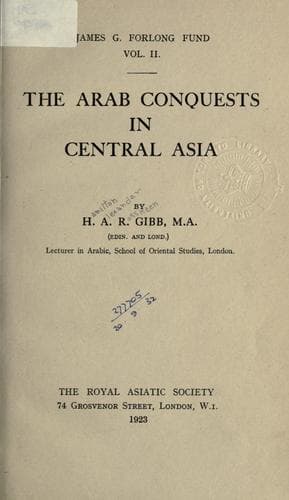
The Arab conquests in Central AsiaGibb, H. A. R. (Hamilton Alexander Rosskeen)
Islamic
The Arab conquests in Central Asia
Gibb, H. A. R. (Hamilton Alexander Rosskeen)
Bukhoro (Uzbekistan) -- History; Islamic Empire; Khanate of Bukhara -- History
The rise of the Central Asian empire of the Turks proper (Tu-Kueh) dates
from their overthrow of the Juan-Juan in Mongolia in 552, under their
great Khan, Mokan. His brother Istämi (the Silzibul of the Byzantine
historians), the semi-independent jabghu of the ten tribes of Western
Turks, after consolidating his power in the Ili and Chu valleys, formed
an alliance with Khusrū Anūshīrwān, and in a joint attack between 563
and 568 the two powers completely overthrew the Ephthalite kingdom and
divided their territories. For a brief moment the Oxus was the actual
boundary between Īrān and Tūrān; under pressure from the silk traders of
Sogdiana, however, the alliance was broken and the weaker successors of
Anūshīrwān could scarcely do more than maintain their outpost garrisons
on the Murghāb. From this time the Ephthalites, like the Kushans, were
gradually assimilating to the Iranian population[5], though the change
was less rapid in the Cisoxine lands of Lower _T_ukhāristān, Bādghīs,
and Herāt, where Ephthalite principalities were re-constituted, probably
with Turkish support, and continued to give Persia much trouble on her
north-eastern frontiers[6]. On the other hand the Turks of the five
western tribes (Nu-she-pi), who became independent after the break up of
the Great Khanate about 582, maintained their suzerainty over Sogdiana
and the middle Oxus basin by frequent expeditions, in one case at least
as far as Balkh. There is no trace in our records of extensive Turkish
immigration into the conquered lands; at most, small groups of Turks
wandered south with their herds, especially, it would seem, south of the
Iron Gate[7]. In general, Turkish interference in the administration
of the subject principalities was at first limited to the appointment
of military governors and the collection of tribute. Thus, in the
semi-legendary account given by An-Naysābūrī of the Turkish conquest of
Bukhārā the Bukhār Khudāh is represented as the chief dihqān under the
Turkish governor. It is possible also that the native princes maintained
guards of Turkish mercenaries.
Public-domain text, read in full here on John Shaqi.
Reviews
Reviews
No reviews yet
Be the first to share your thoughts on this work.
Join the Discussion
Join the discussion
Sign in to leave a comment or review.
Sign InorCreate an account