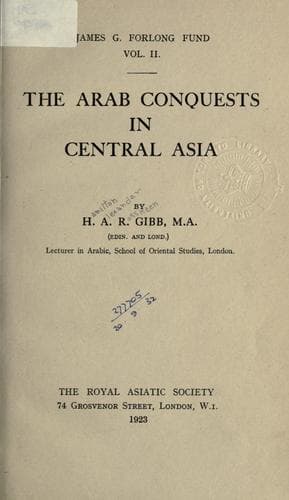
The Arab conquests in Central AsiaGibb, H. A. R. (Hamilton Alexander Rosskeen)
Islamic
The Arab conquests in Central Asia
Gibb, H. A. R. (Hamilton Alexander Rosskeen)
Bukhoro (Uzbekistan) -- History; Islamic Empire; Khanate of Bukhara -- History
The helplessness of their Turkish suzerain in face of the victorious
Arabs, however, caused a revival in Transoxania of the tradition of
Chinese overlordship. Appeals to the Khāqān were of no avail, and in the
minds of the Sogdian princes, seeking for some counterpoise to the rapid
extension of the Arab conquests, the idea of appealing directly to the
Emperor was slowly maturing. Though no definite steps in this direction
had as yet been taken, some inkling of it may have reached Qutayba. The
Arabs were now familiar with China through the sea-borne trade of the
Persian Gulf and at least after, if not before, their conquest of the
cities which were already becoming the headquarters of Central Asian
commerce, must have become aware of the close commercial relations
which these cities maintained with China. Under these circumstances,
Qutayba (or possibly _H_ajjāj) decided to send a mission overland to
the Chinese court, possibly to prevent their intervention in the West,
but more probably with the intention of promoting trade relations. As
the princes of Sogdiana and _T_ukhāristān were much more alive to the
advantages of preserving their commerce and to the dangers which might
befall it under the new government than the Arabs could have been, it was
probably on their suggestion that the embassy was sent. They would, of
course, have no difficulty in persuading governors of the character of
_H_ajjāj and Qutayba that their own interests also lay in safeguarding
and encouraging the trade which brought such wealth to Transoxania.
If the intervention of the Turks had been caused by their concern for
Sogdian trade, it became doubly important for the Arabs to show their
practical interest in its welfare. Apart from the immediate gain to the
treasury which would accrue, such an action might reasonably be expected
to secure the acquiescence of the Sogdians in Arab rule. The date of the
mission is fixed as 713 by the Chinese records, which add also that in
spite of the refusal of the envoys to perform the customary kow-tow it
was favourably received by the Emperor. Both statements are confirmed by
_T_abarī’s remark that the leader was sent to Walīd on his return, which
must therefore be dated between the death of _H_ajjāj and the end of
714[64]. Unfortunately the Arab records of the mission have been confused
with the legendary exploits of Qutayba two years later, becoming so
disfigured in the process as to be almost worthless. The wisdom of this
step must have been justified by its results, though there are no effects
apparent in our histories and the relentless march of Chinese policy was
not affected. This embassy is mentioned by the Arabic historians as if it
were an isolated incident, but it was, as I have shown elsewhere[65],
only the first of many such sent by the governors of Khurāsān to maintain
friendly relations with the Chinese court. It cannot be doubted that
in the majority of cases at least the object of these missions was
Public-domain text, read in full here on John Shaqi.
Reviews
Reviews
No reviews yet
Be the first to share your thoughts on this work.
Join the Discussion
Join the discussion
Sign in to leave a comment or review.
Sign InorCreate an account