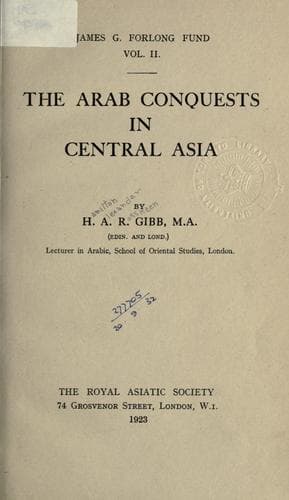
The Arab conquests in Central AsiaGibb, H. A. R. (Hamilton Alexander Rosskeen)
Islamic
The Arab conquests in Central Asia
Gibb, H. A. R. (Hamilton Alexander Rosskeen)
Bukhoro (Uzbekistan) -- History; Islamic Empire; Khanate of Bukhara -- History
On their choosing the latter,
the terms were faithfully carried out after an exchange of hostages.
The fame of the defence of Kamarja spread far and wide, but it brought
little relief to the pressure on the Arabs in Transoxania. Even Khwārizm
was affected by the movement of revolt, but at the first symptoms of open
rebellion it was crushed by the local Muslims, probably Arabs settled
in the district, with the aid of a small force despatched by Ashras.
The reference made in _T_abarī to assistance given to the rebels by the
Turks is probably to be discounted, as is done by Ibn al-Athīr. It is of
course quite possible that the movement was instigated by the Türgesh,
though no such explanation is necessary, but if any Turks were engaged
they were probably local nomadic tribes. Ashras seems to have remained
before Bukhārā during the winter, possibly in Paykand; the Türgesh
probably withdrew towards Shāsh and Farghāna.
In the following year, 730/111-112[88], the attacks on the army of
Ashras were renewed. The course of events can only be gathered from the
accounts given of the difficulties experienced by the new governor,
Junayd b. ʿAbdur-Ra_h_mān al-Murrī, in joining the army before Bukhārā.
His guide advised him to levy a force from Zamm and the neighbouring
districts before crossing the Oxus but Junayd refused, only to find
himself after crossing put to the necessity of calling on Ashras for a
bodyguard of cavalry. This force narrowly escaped disaster on its way to
meet Junayd and fought a second severe engagement on the return journey
before reaching Paykand. The enemy are variously described as “men of
Bukhārā and _S_ughd” and “Turks and _S_ughdians”; it may therefore be
assumed that they were the same forces against whom Ashras had fought the
previous year. Wellhausen is probably correct in supposing that Ashras
was practically beleaguered, though not in Bukhārā. The recapture of this
city and the retiral of Khāqān took place shortly after Junayd’s arrival,
in circumstances which are not described[89]. The attitude of Tugshāda
during this episode is not recorded. It is practically certain, however,
that he remained in Bukhārā, and after the reconquest was able to make
his peace with the Arabs, probably on the excuse of _force majeure_. At
all events he retained his position, possibly because Junayd thought it
impolitic in the face of the situation to victimise the nobles in the
reconquered territories and thus provoke a more stubborn resistance in
the rest of the country. The Arabs seem to have followed up the Turks
towards Samarqand, probably to relieve the garrison; the two armies met
again at Zarmān, seven farsakhs from Samarqand, where the Arabs claimed
a success, one of their prisoners being a nephew of Khāqān. From _S_ughd
the army marched to Tirmidh where Junayd halted for two months in the
friendly atmosphere of Chaghāniān before returning to Merv. His intention
was no doubt to make arrangements for the pacification or reconquest of
Public-domain text, read in full here on John Shaqi.
Reviews
Reviews
No reviews yet
Be the first to share your thoughts on this work.
Elsewhere in the archive
Join the Discussion
Join the discussion
Sign in to leave a comment or review.
Sign InorCreate an account