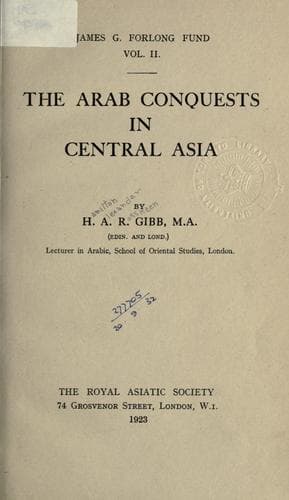
The Arab conquests in Central AsiaGibb, H. A. R. (Hamilton Alexander Rosskeen)
Islamic
The Arab conquests in Central Asia
Gibb, H. A. R. (Hamilton Alexander Rosskeen)
Bukhoro (Uzbekistan) -- History; Islamic Empire; Khanate of Bukhara -- History
_T_ukhāristān and Khuttal; in the following year his troops were actually
engaged in this direction when the Türgesh invasion of _S_ughd forced him
to change his plans. Balādhurī quotes Abū ʿUbayda for the statement that
Junayd reconquered certain districts in _T_ukhāristān which had revolted.
How lightly even yet factional feeling was slumbering was shown after the
return of the army, when the Bāhilites of Balkh had a chance to retaliate
on Na_s_r b. Sayyār for their discomfiture at Barūqān. Though Junayd was
prompt to punish the offending governor, the incident throws a strong
light on one cause of the weakness of the Arabs in these campaigns.
Early in 731/112-113, the Türgesh and _S_ughdians gathered their forces
for the investment of Samarqand. Ghūrak now openly joined the Khāqān.
Sawra b. Al-_H_urr, the governor of Samarqand, unable to face the enemy
in the field, sent an urgent message to Junayd for assistance. The
governor hastily recalled his troops, but crossed the river without
waiting for them against the advice of his generals. “No governor of
Khurāsān,” said al-Mujashshar b. Muzā_h_im, one of the ablest of the Arab
commanders, “should cross the river with less than fifty thousand men.”
Accompanied only by a small force, Junayd reached Kish, where he raised
some local levies and prepared to march on Samarqand. The enemy in the
meantime, after blocking up the water supplies on his road, interposed
their forces between Samarqand and the army of relief. Junayd thereupon
decided to follow the direct route across the Shāwdār mountains in
the hope of avoiding an engagement, but when only four farsakhs from
Samarqand was surprised in the defiles by Khāqān. The advance-guard
was driven in and the main body engaged in a furious struggle in which
both sides fought to a standstill. The Arabs, hemmed in on all sides,
were forced to entrench; stragglers, refugees, and baggage, collected
near Kish, were attacked by a detachment of Turks and severely handled.
Khāqān renewed his attacks on the camp the next day, all but overwhelming
Junayd, and settled down thereafter to beleaguer him. In this predicament
there was only one course open to Junayd. Had his force perished,
Samarqand would certainly have fallen in the end and two disasters taken
the place of one. He therefore adopted the more prudent, if unheroic,
course of ordering Sawra to leave a skeleton garrison in Samarqand and
march out to join him by way of the river: Sawra, however, took the short
cut across the mountains, and was actually within four miles of Junayd,
when the Turkish forces bore down on him. The battle lasted into the heat
of the day, when the Turks, on Ghūrak’s advice it is said, having first
set the grass on fire, drew up so as to shut Sawra off from the water.
Maddened by heat and thirst, the Arabs charged the enemy and broke their
ranks, only to perish miserably in the fire, Turks and Muslims together.
Public-domain text, read in full here on John Shaqi.
Reviews
Reviews
No reviews yet
Be the first to share your thoughts on this work.
Elsewhere in the archive
Join the Discussion
Join the discussion
Sign in to leave a comment or review.
Sign InorCreate an account