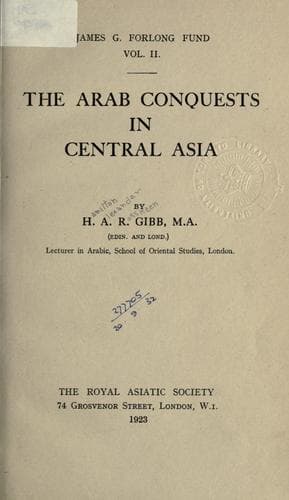
The Arab conquests in Central AsiaGibb, H. A. R. (Hamilton Alexander Rosskeen)
Islamic
The Arab conquests in Central Asia
Gibb, H. A. R. (Hamilton Alexander Rosskeen)
Bukhoro (Uzbekistan) -- History; Islamic Empire; Khanate of Bukhara -- History
The scattered remnants were pursued by the Turkish cavalry and of twelve
thousand men scarcely a thousand escaped. While the enemy were engaged
with Sawra, Junayd freed himself from his perilous position in the
defiles, though not without severe fighting, and completed his march to
Samarqand. _T_abarī gives also a variant account of the “Battle of the
Pass,” the main difference in which is the inclusion of the Jabghu on the
side of the Turks. In view of the Arab expeditions into _T_ukhāristān, it
is improbable that the Jabghu, even if he was present personally, which
is doubtful, was accompanied by any of his troops. The Persian _T_abarī
also contains an entirely different version of the Battle of the Pass and
the fate of Sawra. The original version is amply attested by contemporary
poets, who show no mercy to Junayd. Whatever credit the Arabs gained
in this battle is reflected on Na_s_r b. Sayyār and the mawālī. Junayd
remained at Samarqand for some time, recuperating his forces, while
couriers were sent to Hishām with the news of the disaster. The Caliph
immediately ordered twenty thousand reinforcements from Ba_s_ra and Kūfa
to be sent to Khurāsān, together with a large number of weapons and a
draft on the treasury, at the same time giving Junayd a free hand in
enlistment.
The Turks, disappointed in their attack on Samarqand, withdrew to
Bukhārā, where they laid siege to Qa_t_an b. Qutayba. Here they were also
on the natural lines of communication between Samarqand and Khurāsān.
Junayd held a council, and of three alternatives, either to remain in
Samarqand and await reinforcements, or to retire on Khurāsān _via_ Kish
and Zamm, or to attack the enemy, chose the last. But the morale of the
Arabs was sadly shaken; a garrison of eight hundred men for Samarqand
was scraped together only by granting a considerable increase in their
pay, while the troops openly regarded the decision to face Khāqān and
the Turkish hordes as equivalent to courting destruction. Junayd now
marched with the utmost circumspection, however, and easily defeated a
small body of the enemy in a skirmish near Karmīnīa. The following day
Khāqān attacked his rearguard near _T_awāwīs (on the edge of the oasis
of Bukhārā), but the attack had been foreseen and was beaten off. As it
was now well into November, the Türgesh were compelled to withdraw from
Sogdiana, while Junayd entered Bukhārā in triumph on the festival of
Mihrjān. In Chaghāniān he was joined by the reinforcements, whom he sent
on to Samarqand, the remainder of the troops returning to their winter
quarters.
Public-domain text, read in full here on John Shaqi.
Reviews
Reviews
No reviews yet
Be the first to share your thoughts on this work.
Elsewhere in the archive
Join the Discussion
Join the discussion
Sign in to leave a comment or review.
Sign InorCreate an account