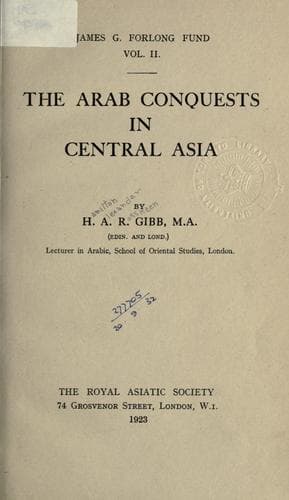
The Arab conquests in Central AsiaGibb, H. A. R. (Hamilton Alexander Rosskeen)
Islamic
The Arab conquests in Central Asia
Gibb, H. A. R. (Hamilton Alexander Rosskeen)
Bukhoro (Uzbekistan) -- History; Islamic Empire; Khanate of Bukhara -- History
Junayd seems to have been content with saving Samarqand and Bukhārā. As
no further expeditions are recorded of his two remaining years of office
it must be assumed that the situation in _S_ughd remained unchanged and
that the Türgesh irruptions also were suspended. Though the Arabs still
held Samarqand and the territories of Bukhārā and Kish, they were in
all probability confined to these, while in the southern basin their
authority hardly extended beyond Balkh and Chaghāniān. Both sides may
have awaited the first move by the other, but were surprised by the
appearance of a new factor, which threatened the existence of Arab
sovereignty in the Far East more seriously than any external danger. It
is noteworthy that in his last year of office (115/733) Junayd resumed
relations with the Chinese court. The Turkish title of the leader of the
embassy, Mo-se-lan Tarkan, suggests that none of the ambassadors were
actually Arabs, but that the governor had commissioned some dignitaries
from the subject states to represent the Arab government. The only
embassy recorded in this year from a native state, however, came from
Khuttal. In the same year Khurāsān was visited by a severe drought
and famine, and to provide for the needs of Merv, Junayd commandeered
supplies from all the surrounding districts. This, added to the military
disasters of the last few years and the insinuations of Shīʿite
propaganda, provoked open discontent in the district which had hitherto
been outwardly faithful to Merv, namely the principalities of Lower
_T_ukhāristān. The leader of the malcontents was Al-_H_ārith b. Surayj,
who was flogged in consequence by the governor of Balkh. The discontent
flared into open revolt on the death of Junayd in Mu_h_arram 716 (Feb.
734). _H_ārith, assisted by the princes and people of Jūzjān, Fāryāb, and
_T_ālaqān, marched on Balkh and captured it from Na_s_r b. Sayyār. The
versions leave it uncertain whether _H_ārith defeated Na_s_r and then
captured the city or whether he entered the city first and beat off an
attempt at recapture by Na_s_r. (Wellhausen’s reference to the Oxus is
due to his so misunderstanding the “river of Balkh” in _T_ab. 1560. 2.
That it refers here, as frequently, to the Dehas river is clear from the
distance to the city (2 farsakhs, whereas the Oxus lay twelve farsakhs
from Balkh) as well as from the mention of the bridge of ʿA_t_ā.) From
Balkh he moved against the new governor ʿĀ_s_im b. ʿAbdullah al-Hilālī,
at Merv, capturing Merv-Rūdh on the way. ʿĀ_s_im found a large section
of the inhabitants in league with _H_ārith, but on his threatening to
evacuate Merv and to call for Syrian troops, the local forces rallied
round him. At the first reverse, the princes of Lower _T_ukhāristān
deserted _H_ārith, whose army fell from sixty thousand to three thousand.
He was thus reduced to making terms with ʿĀsim, but early in the
following year renewed his revolt. ʿĀsim, hearing that Asad b. ʿAbdullah
Public-domain text, read in full here on John Shaqi.
Reviews
Reviews
No reviews yet
Be the first to share your thoughts on this work.
Elsewhere in the archive
Join the Discussion
Join the discussion
Sign in to leave a comment or review.
Sign InorCreate an account