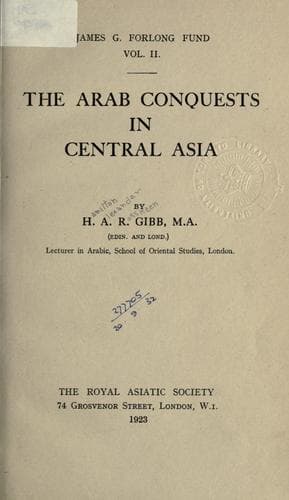
The Arab conquests in Central AsiaGibb, H. A. R. (Hamilton Alexander Rosskeen)
Islamic
The Arab conquests in Central Asia
Gibb, H. A. R. (Hamilton Alexander Rosskeen)
Bukhoro (Uzbekistan) -- History; Islamic Empire; Khanate of Bukhara -- History
was on the way as his successor, began to intrigue with _H_ārith against
him. The plan miscarried, however; _H_ārith seized the governor and held
him to ransom, so that Asad on his arrival found the rebels in possession
of all Eastern Khurāsān, and Merv threatened both from the East and from
the South. Sending a force under ʿAbdur Ra_h_mān b. Nuʿaym towards Merv
Rūdh to keep _H_ārith’s main body in check, he marched himself against
the rebel forces at Āmul and Zamm. These took refuge in the citadel of
Zamm, and Asad, having thus checked the insurgents in this quarter,
continued his march on Balkh. Meanwhile _H_ārith seems to have retreated
before ʿAbdur-Ra_h_mān towards Balkh and thence across the Oxus, where he
laid siege to Tirmidh. Lower _T_ukhāristān returned to its allegiance;
on the other hand _H_ārith was now supported not only by the kings of
Khuttal and Nasaf, but also, as appears from later events, by the Jabghu
of _T_ukhāristān. The government troops were unable to cross the Oxus
in the face of _H_ārith’s army; finding, however, that the garrison was
well able to defend itself, they returned to Balkh, while _H_ārith,
after falling out with the king of Khuttal, seems to have retired into
_T_ukhāristān. Here, following the example of Mūsā b. Khāzim at Tirmidh,
he made a safe retreat for himself in Badakhshān.
The motives of _H_ārith’s rebellion have been most variously estimated.
In spite of the unctuous sentiments which he is represented as uttering
on all occasions, it is hard to find in him the “pious Muslim, ascetic
and reformer” whom van Vloten too sharply contrasts with the government
officials[90]. In spite too of the prominent position given to him in
the Arabic chronicles, it may even be questioned whether he and his
small personal following were not rather the tools than the leaders of
the elements making for the overthrow of the Umayyad administration in
Khurāsān. At all events the weakness of his hold over his temporary
followers is much more striking than his transient success. Further
evidence of this is given in a most important narrative prefaced by
_T_abarī to his account of Asad’s expedition into _S_ughd. Except for the
scantiest notices, the Arabic historians have nothing to say regarding
the effects of the war in Khurāsān on the situation in Transoxania.
Wellhausen’s conclusion (based apparently on _T_abarī 1890. 6) that
“_H_ārith first unfurled the black flag in Transoxania in the last
year of Junayd” is scarcely tenable. There is further no evidence at
all for his assumption that Samarqand had fallen into the hands of the
_H_ārithites, especially as Bukhārā remained loyal to the administration.
That Asad’s expedition was not, in fact, directed against _H_ārith
follows in the clearest possible manner from the narrative referred to
(_T_ab. 1585. 6-16).
Public-domain text, read in full here on John Shaqi.
Reviews
Reviews
No reviews yet
Be the first to share your thoughts on this work.
Elsewhere in the archive
Join the Discussion
Join the discussion
Sign in to leave a comment or review.
Sign InorCreate an account