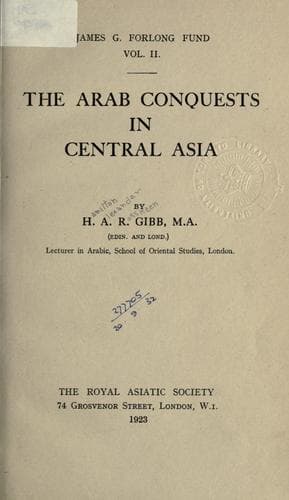
The Arab conquests in Central AsiaGibb, H. A. R. (Hamilton Alexander Rosskeen)
Islamic
The Arab conquests in Central Asia
Gibb, H. A. R. (Hamilton Alexander Rosskeen)
Bukhoro (Uzbekistan) -- History; Islamic Empire; Khanate of Bukhara -- History
erroneously taken as the title Tarkhān, though it is in reality only the
Arabic transcription of a personal name spelt in the Chinese records
Tu-hoen. During the six or seven hundred years of their rule all these
princes had become fully identified with their Iranian subjects[10]. The
“kingship” moreover was not a real monarchy but rather the primacy in
an oligarchical system. Their authority was far from absolute, and the
landed aristocracy (dihqāns) and rich merchants possessed, as will be
seen later, not only a large measure of independence but also on occasion
the power to depose the ruling prince and elect his successor. As the
succession appears to have been largely hereditary it is probable that,
according to Iranian custom, eligibility was confined to a single royal
house. In some cases, it would seem, the succession was regulated during
the lifetime of the reigning prince by some such method as association in
the principate, probably combined with the appointment of the remaining
princes to other fiefs[11].
The “confederacy” of these states, however, was in no sense an alliance
and probably amounted to little more than a _modus vivendi_. Besides
the more important princes there existed an enormous number of petty
autocrats, some possibly Turkish, others probably descended from former
conquerors, whose authority may sometimes have scarcely extended beyond
the limits of their own villages. In lands subject to the Turks and
patrolled by nomadic tribes an effective centralised government was
hardly possible. Mutual antagonisms and wars cannot have been uncommon
though we have now no record of them, except that during the early Arab
period there was hostility between Bukhārā and Wardāna, but the latter
cannot be reckoned among the Shao-wu principalities since, according
to Narshakhī, it was founded by a Sāsānid prince about 300 A.D. Until
the profitable Chinese trade was threatened by the Arabs we find no
trustworthy record of combined resistance offered by the country to its
piecemeal reduction, and only long after the conquests of Qutayba is
there any hint of a concerted rising. At the same time, the strength of
the cities and warlike nature of their inhabitants may be gauged from the
way in which they not only preserved themselves from destruction at the
hands of their successive nomad invaders, but even gained their respect,
while this, in some respects perhaps the most highly civilised of all
the lands subdued by the Arabs[12], proved also the most difficult to
conquer, and most intractable to hold.
Public-domain text, read in full here on John Shaqi.
Reviews
Reviews
No reviews yet
Be the first to share your thoughts on this work.
Join the Discussion
Join the discussion
Sign in to leave a comment or review.
Sign InorCreate an account