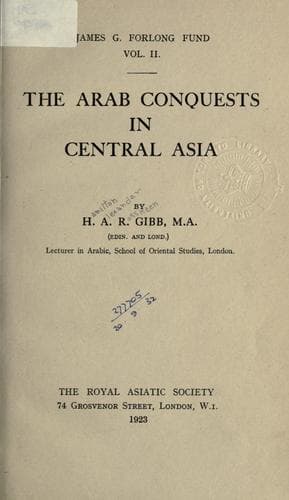
The Arab conquests in Central AsiaGibb, H. A. R. (Hamilton Alexander Rosskeen)
Islamic
The Arab conquests in Central Asia
Gibb, H. A. R. (Hamilton Alexander Rosskeen)
Bukhoro (Uzbekistan) -- History; Islamic Empire; Khanate of Bukhara -- History
The same lack of unity is apparent in the districts south of the Iron
Gate, though nominally subject to a single authority. It is important
to bear in mind that the Zarafshān and Oxus valleys were completely
independent of one another—that the difference between them was not
merely one of government, but also of language, and even, to some extent,
of blood, owing to the greater mixture of races in the southern basin.
When, occasionally, as in the “Mūsā legend”, reference is made in the
Arabic histories to common action by _S_ughd and _T_ukhāristān, it is
due to a complete misunderstanding of the state of the country prior to
the conquest, and it is worthy of notice that no such reference is to
be found in any narrative otherwise reliable. On his outward journey in
630, Yuan Chwang found the country divided into twenty-seven petty states
under separate rulers, with the chief military authority vested in the
Turkish Shād, the eldest son of the Jabghu of the Western Turks, who
had his seat near the modern Qunduz. During the period of anarchy which
befell the Western Turks in the following years, the whole district was
formed into an independent kingdom under a son of the former Shād, who
founded the dynasty of Jabghus of _T_ukhāristān. Minor Turkish chiefs
and intendants probably seized similar authority in their own districts,
and though the Jabghu was recognised as suzerain of all the lands from
the Iron Gate to Zābulistān and Kapisa and from Herāt to Khuttal[13],
his authority was little more than nominal except within his immediate
district of Upper _T_ukhāristān. The lesser princes, in Shūmān, Khuttal,
&c., many of whom were Turkish, appear to have acted quite independently
and did not hesitate to defy their Suzerain on occasion. The name
_T_ukhāristān is used very loosely in the Arabic records, with misleading
effect[14]. How relatively unimportant to the Arabs _T_ukhāristān proper
was is shown by the fact that its annexation (see below p. 38) is passed
over in silence. The brunt of the resistance offered to the early Arab
conquests was borne by the princes of _Lower_ _T_ukhāristān, _i.e._,
the riverain districts south of the Iron Gate, including Chaghāniān and
Balkh, together with the Ephthalite principalities in Jūzjān, Bādghīs,
and Herāt, and possibly the mountainous fringe of Gharjistān. This
explains why the Arabs always regarded Balkh, the old religious capital
of the Kushan Empire and site of the famous Buddhist shrine of Nawbahār,
as the capital of the “Turks”; it was in fact the centre of what we
might almost term the “amphictyony” of Lower _T_ukhāristān, combining
strategic and commercial importance with religious veneration. Long after
the Nawbahār had been destroyed by Ibn ʿĀmir this sentiment continued to
exist in the country[15].
Public-domain text, read in full here on John Shaqi.
Reviews
Reviews
No reviews yet
Be the first to share your thoughts on this work.
Join the Discussion
Join the discussion
Sign in to leave a comment or review.
Sign InorCreate an account