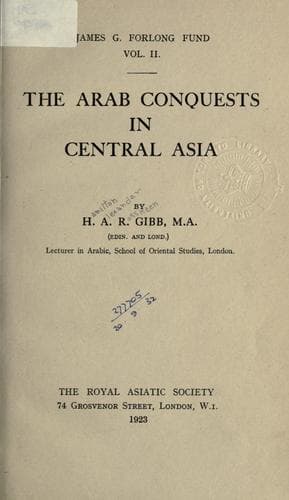
The Arab conquests in Central AsiaGibb, H. A. R. (Hamilton Alexander Rosskeen)
Islamic
The Arab conquests in Central Asia
Gibb, H. A. R. (Hamilton Alexander Rosskeen)
Bukhoro (Uzbekistan) -- History; Islamic Empire; Khanate of Bukhara -- History
Of much greater, and indeed decisive, importance were the results of
an expedition under Ziyād b. Sāli_h_ into the Turkish lands beyond
the Jaxartes. It is surprising to find no reference to this either in
_T_abarī or any other of the early historians. A short notice is given
by Ibn al-Athīr, drawn from some source which is now apparently lost.
The earliest reference which we find in the Arabic histories seems to
be a passing mention of Ziyād b. Sāli_h_’s expedition “into _S_īn”
in a monograph on Baghdād by Ibn _T_ayfūr (d. 250/983)[110]. For a
detailed account of the battle we are therefore dependent on the Chinese
sources[111]. In 747 and 749 the Jabghu of _T_ukhāristān had appealed
to China for aid against certain petty chiefs who were giving trouble
in the Gilghit and Chitral valleys. The governor of Kucha despatched on
this duty a Corean officer, Kao-hsien-shih, who punished the offenders
in a series of amazing campaigns over the high passes of the Karakorum.
Before returning to Kucha after the last campaign he was called in by the
King of Farghāna to assist him against the king of Shāsh. Kao-hsien-shih
at first came to terms with the king of Shāsh but when on some pretext
he broke his word and seized the city, the heir to the kingdom fled to
_S_ughd for assistance and persuaded Abū Muslim to intervene. A strong
force was accordingly despatched under Ziyād b. Sāli_h_. The Chinese,
with the army of Farghāna and the Karluks (who had succeeded the Türgesh
in the hegemony of the Western Turks), gave battle at Athlakh, near
_T_arāz, in July 751 (Dhuʾl-_h_ijja 133). During the engagement the
Karluks deserted and Kao-hsien-shih, caught between them and the Arabs,
suffered a crushing defeat. Though this battle marks the end of Chinese
power in the West, it was in consequence of internal disruption rather
than external pressure. Nothing was further at first from the minds of
the princes of _S_ughd than the passing of the long tradition of Chinese
sovereignty, indeed it blazed up more strongly than ever. For had not
a Chinese army actually visited Shāsh on their very borders; even if
the Arabs had won the first battle, would they not return to avenge the
defeat? For the last time the Shao-wu princes planned a concerted rising
in Bukhārā, Kish, _S_ughd, and Ushrūsana. But China gave neither aid
nor encouragement; the presence of Abū Muslim at Samarqand overawed the
_S_ughdians, and only at Kish did the revolt assume serious proportions.
Abū Dāwud’s army easily crushed the insurgents in a pitched battle at
Kandak, near Kish, killing the king Al-Ikhrīd and many of the other
dihqāns. Amongst the treasures of the royal palace which were sent to
Samarqand were “many articles of rare Chinese workmanship, vessels inlaid
with gold, saddles, brocades, and other objects d’art.” The Bukhār-Khudāh
Qutayba and the dihqāns of _S_ughd also paid for their complicity with
their lives[112].
Public-domain text, read in full here on John Shaqi.
Reviews
Reviews
No reviews yet
Be the first to share your thoughts on this work.
Elsewhere in the archive
Join the Discussion
Join the discussion
Sign in to leave a comment or review.
Sign InorCreate an account