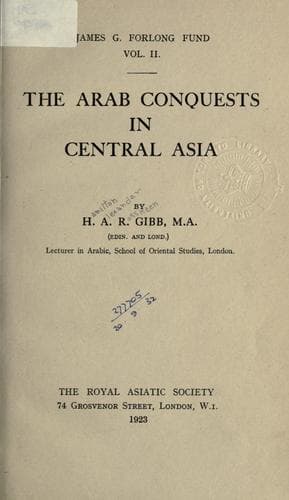
The Arab conquests in Central AsiaGibb, H. A. R. (Hamilton Alexander Rosskeen)
Islamic
The Arab conquests in Central Asia
Gibb, H. A. R. (Hamilton Alexander Rosskeen)
Bukhoro (Uzbekistan) -- History; Islamic Empire; Khanate of Bukhara -- History
So ended the last attempt at restoring an independent Sogdiana under
the old régime. For some years yet the princes of _S_ughd, Khwārizm,
and _T_ukhāristān continued to send appeals to China. The Emperor,
however, “preoccupied with maintaining peace, praised them all and gave
them consolation, then having warned them sent them back to assure
tranquillity in the Western lands.” Abū Muslim had also, it would seem,
realised the importance of maintaining relations with the Chinese court,
for a succession of embassies from “the Arabs with black garments” is
reported, beginning in the year following the battle of the Talas.
As many as three are mentioned in a single year. It is possible that
these embassies were in part intended to keep the government informed
on the progress of the civil wars in China, though the active interest
of the new administration in their commerce would, as before, tend to
reconcile the influential mercantile communities to ʿAbbāsid rule. The
actual deathblow to the tradition of Chinese overlordship in Western
Central Asia was given, not by any such isolated incident as the battle
of the Talas, but by the participation of Central Asian contingents in
the restoration of the Emperor to his capital in 757[113]. Men from the
distant lands to whom China had seemed an immeasurably powerful and
unconquerable Empire now saw with their own eyes the fatal weaknesses
that Chinese diplomacy had so skilfully concealed. From this blow Chinese
prestige never recovered.
The complete shattering of the Western Turkish empires by the Chinese
policy had also put an end to all possibility of intervention from that
side. Transoxania, therefore, was unable to look for outside support,
while the reorganization of the Muslim Empire by the early ʿAbbāsid
Caliphs prevented, not indeed sporadic though sometimes serious risings,
but any repetition of the concerted efforts at national independence.
The Shao-wu princes and the more important dihqāns continued to exercise
a nominal rule until the advent of the Sāmānids, but many of them
found that the new policy of the Empire offered them an opportunity of
honourable and lucrative service in its behalf and were quick to take
advantage of it. On the other hand the frequent revolts in Eastern
Khurāsān under the guise of religious movements show that the mass of the
people remained unalterably hostile to their conquerors[114]. In none of
these, however, was the whole of Transoxania involved until the rising
organized by Rāfiʿ b. Layth three years after the fall of the Barmakids.
The extraordinary success of his movement may partly be ascribed to
resentment at their disgrace, but it perhaps counted for something that
he was the grandson of Na_s_r b. Sayyār. Though the revolt failed it led
directly to the only solution by which Transoxania could ever become
reconciled to inclusion in the Empire of the ʿAbbāsids. Whether by wise
judgment or happy chance, to Maʿmūn belongs the credit of laying the
Public-domain text, read in full here on John Shaqi.
Reviews
Reviews
No reviews yet
Be the first to share your thoughts on this work.
Elsewhere in the archive
Join the Discussion
Join the discussion
Sign in to leave a comment or review.
Sign InorCreate an account