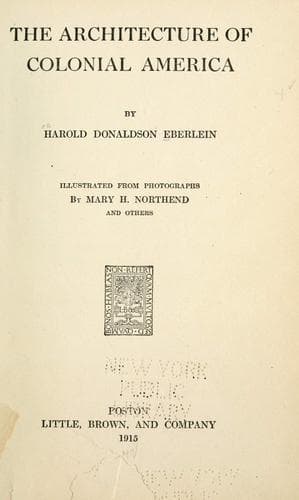
The Architecture of Colonial AmericaEberlein, Harold Donaldson
History
The Architecture of Colonial America
Eberlein, Harold Donaldson
Architecture -- United States; Architecture, Colonial
This neo-classic inspiration of Napoleonic French contrivance found
favour in America, thanks to the strong Francophile sentiment prevailing
in the latter part of the eighteenth century and at the beginning of the
nineteenth, which even dictated the colour and design of ladies’ gowns
and their method of coiffure. In the able hands of such men as Charles
Bulfinch, the neo-classic manifestation well merited all the popular
approval accorded it. It is scarcely fair, however, to put Bulfinch
forth, at least in his earlier period, as a typical exponent of Classic
Revival architecture. He was, it is true, imbued with the new
influences but he had too much creative instinct and too much sense of
fitness ever to descend to mere copying or wholesale borrowing. Besides,
he was, one might say, by date of birth and training, a product of the
Adam age and, by native bias, in full sympathy with its delicate and
refined methods of expression. Indeed, we may properly regard Bulfinch
as marking the transition from the Adam or last phase of Georgian
architecture to the modes of the Classic Revival for he combined in his
work many of the best features of both. He knew how and when to employ
Adam delicacy and refinement of detail or Adam exuberance of
embellishment without falling into a surfeit of finicky and saccharine
over-elaboration; he knew also when and where to use classic boldness
and vigour and even classic austerity without sinking from classic grace
into any of the heavy Roman forms of brutal vulgarity and military
bombast that sometimes marred the work of later exponents of Classic
Revival inspiration.
Bulfinch was possessed of consummate good taste, a fine sense of
proportion and a genius for judicious adaptation. He was educated while
the Adam influence was at its height, had broadened his field by
observation and foreign travel and began to practise just before the
first fresh impetus of direct classicism was launched. It was,
therefore, quite natural that, with his trained perception and happy
faculty of selection and combination, he should have picked out the best
in each school, and peculiarly appropriate that his work should
exemplify the transitional stage by which one was merged into the other
for, in the evolutionary process, already alluded to, the purest form of
neo-classic design found its analogue in the earlier Adam practice.
Public-domain text, read in full here on John Shaqi.
Reviews
Reviews
No reviews yet
Be the first to share your thoughts on this work.
Elsewhere in the archive
Join the Discussion
Join the discussion
Sign in to leave a comment or review.
Sign InorCreate an account