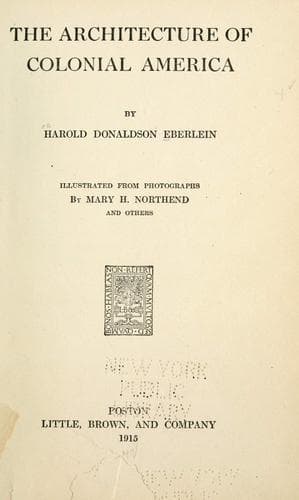
The Architecture of Colonial AmericaEberlein, Harold Donaldson
History
The Architecture of Colonial America
Eberlein, Harold Donaldson
Architecture -- United States; Architecture, Colonial
whichever one prefers to call it, were not of common occurrence it is
pleasant to record. They were the exception, and served to lend point to
the really excellent and creditable things that were achieved at a time
when a decorous formality went hand in hand with cultivated taste and
not a little vigour of thought.
The mutation of architectural style from the Georgian mode to that of
the Classic Revival was virtually synchronous and correspondent with the
sway of the Empire styles in furniture, the decorative arts and personal
attire. The Classic Revival style is altogether post-Colonial in date
and its exotic impetus and inspiration, derived from the France of the
First Napoleon and grafted upon a Georgian stock, cannot be regarded as
essentially a part of the logical process of architectural evolution
which had hitherto progressed by gradual and, for the most part, well
nigh imperceptible steps from one traditional form to another.
The vigorous classicism of the Georgian period, thanks to its filtration
through Renaissance channels, was elastic and appropriate in its
application. Even the elegancies and refinements of the Adam school of
Georgian expression, though drawn direct from the store of classic
antiquity, were judiciously adapted to current needs by masters of the
art of discrimination. But the type of classicism exemplified in the
Classic Revival was deliberately transplanted bodily and _de novo_ from
the ancient world by Napoleonic fiat, in like manner with the designs
for furniture and the patterns to dominate the products of the other
decorative arts. The transplanters sometimes showed a predilection for
heavy Roman forms rather than for the delicacy of Greek refinements, and
the transplanting was occasionally done in a clumsy way with little
apparent regard for fitness or the principles of sane adaptation. With
all the wealth of antiquity to draw from, it would have been strange
indeed if the fautors of revived classicism had not produced much that
was both exceedingly worthy and beautiful. As pointed out before,
whatever defect or weakness characterised the expression of the Classic
Revival style, viewed in the aggregate, is not to be attributed to the
forms employed but to the manner in which those forms were sometimes
misapplied and forced into uses or combinations to which they were ill
suited.
Public-domain text, read in full here on John Shaqi.
Reviews
Reviews
No reviews yet
Be the first to share your thoughts on this work.
Elsewhere in the archive
Join the Discussion
Join the discussion
Sign in to leave a comment or review.
Sign InorCreate an account