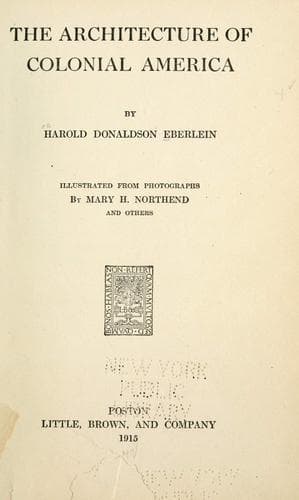
The Architecture of Colonial AmericaEberlein, Harold Donaldson
History
The Architecture of Colonial America
Eberlein, Harold Donaldson
Architecture -- United States; Architecture, Colonial
it been preserved, we should now have an invaluable addition to the
architectural treasures of our country and an interesting commentary
upon the work of one of the earliest architects known to have practised
his profession in the Colonies.
It is most important to remember that some considerable degree of
architectural knowledge or, at the very least, some substantial
cultivation of architectural taste and discrimination seems to have been
considered an indispensable part of every gentleman’s education in the
eighteenth century. Consequently it is not surprising to find that some
of our native amateur architects possessed knowledge and ability by no
means contemptible. Architectural appreciation was favoured by the fact
that not a few of the sons of the wealthy and well-to-do were sent to
England to complete their education and usually spent some time
afterwards in travel on the Continent. Such broadening influences
naturally tended to stimulate and aid the development of architectural
taste and, as a certain amount of dexterity in drawing was highly
esteemed and practised as a polite masculine accomplishment, a
considerable number of men were fitted, to a far greater degree than the
majority of so-called well educated people nowadays, to translate their
architectural preferences into a form sufficiently intelligible for the
master-carpenter to work from in putting an idea into a tangible shape.
It is not to be inferred from the foregoing that a large number of men
of substance and leisure for the cultivation of polite accomplishments
were capable of producing a set of measured drawings, such as
professional architects prepare, to turn over to a contractor for
execution. They were not. But the division of functions was altogether
different. The client, as he would now be termed, showed a more
intelligent and constructive appreciation of architectural principles in
a proportionately larger number of cases than he does at the present
day. He formed a definite conception of what he wished and was capable
of conveying his desires lucidly by means of drawings or rough sketches
to the head workman charged with the actual task of construction. As the
average client was better informed and thought more clearly upon matters
architectural than the client of later times, so, on the other hand, the
master-carpenter of the eighteenth century was infinitely more capable
than the average artisan of like rank to-day. He was not only a skilled
master-mechanic, competent to translate rough draughts and sketches into
carefully prepared working drawings, but he was also a person of some
architectural education and taste and endowed with a nice perception and
valuation of architectural merits and proprieties. He was materially
aided in his work by a number of valuable and explicit architectural
books with measured drawings of whose assistance he did not hesitate
freely to avail himself. Furthermore, he still retained a sympathetic
Public-domain text, read in full here on John Shaqi.
Reviews
Reviews
No reviews yet
Be the first to share your thoughts on this work.
Elsewhere in the archive
Join the Discussion
Join the discussion
Sign in to leave a comment or review.
Sign InorCreate an account