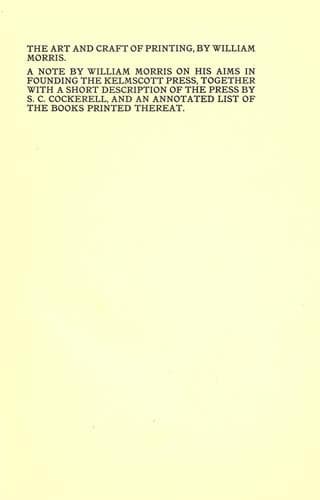
Hammersmith (London, England) -- Imprints; Kelmscott Press; Printing -- Great Britain -- History
And, by the way, I wish to make a protest against the superstition that
only small books are comfortable to read; some small books are tolerably
comfortable, but the best of them are not so comfortable as a fairly big
folio, the size, say, of an uncut Polyphilus or somewhat bigger. The
fact is, a small book seldom does lie quiet, and you have to cramp your
hand by holding it or else put it on the table with a paraphernalia of
matters to keep it down, a tablespoon on one side, a knife on another,
and so on, which things always tumble off at a critical moment, and
fidget you out of the repose which is absolutely necessary to reading;
whereas, a big folio lies quiet and majestic on the table, waiting
kindly till you please to come to it, with its leaves flat and
peaceful, giving you no trouble of body, so that your mind is free to
enjoy the literature which its beauty enshrines.
So far then, I have been speaking of books whose only ornament is the
necessary and essential beauty which arises out of the fitness of a
piece of craftsmanship for the use which it is made for. But if we get
as far as that, no doubt from such craftsmanship definite ornament will
arise, and will be used, sometimes with wise forbearance, sometimes with
prodigality equally wise. Meantime, if we really feel impelled to
ornament our books, no doubt we ought to try what we can do; but in this
attempt we must remember one thing, that if we think the ornament is
ornamentally a part of the book merely because it is printed with it,
and bound up with it, we shall be much mistaken. The ornament must form
as much a part of the book as the type itself, or it will miss its mark,
and in order to succeed, and to be ornament, it must submit to certain
limitations, and become architectural; a mere black and white picture,
however interesting it may be as a picture, may be far from an ornament
in a book; while on the other hand a book ornamented with pictures that
are suitable for that, and that alone, may become a work of art second
to none, save a fine building duly decorated, or a fine piece of
literature.
These two latter things are, indeed, the one absolutely necessary gift
that we should claim of art. The picture-book is not, perhaps,
absolutely necessary to man's life, but it gives us such endless
pleasure, and is so intimately connected with the other absolutely
necessary art of imaginative literature that it must remain one of the
very worthiest things toward the production of which reasonable men
should strive.
AN ESSAY ON PRINTING, BY WILLIAM MORRIS AND EMERY WALKER, FROM ARTS AND
CRAFTS ESSAYS BY MEMBERS OF THE ARTS AND CRAFTS EXHIBITION SOCIETY.
Public-domain text, read in full here on John Shaqi.
Reviews
Reviews
No reviews yet
Be the first to share your thoughts on this work.
Join the Discussion
Join the discussion
Sign in to leave a comment or review.
Sign InorCreate an account