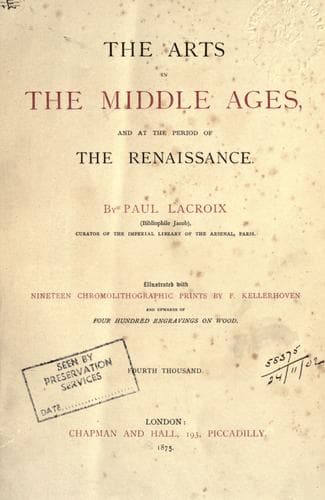
The Arts in the Middle Ages and at the Period of the RenaissanceJacob, P. L.
History
The Arts in the Middle Ages and at the Period of the Renaissance
Jacob, P. L.
Art, Medieval; Art, Renaissance; Middle Ages
From Correggio to Parmigianino the distance is of the kind that
admiration can easily fill up. It was said of the latter that he had
more the appearance of an angel than of a man; and the Romans of his
own day used to add that the spirit of Raphael had passed into his body.
In more than one instance his genius was kindled by the sun of
Correggio, and ripened in the studios of Michael Angelo and Raphael; but
in addition to this, his flexible and varied talent enabled him to find
a place by himself between these two masters. “St. Francis receiving the
Stigmata,” and “The Marriage of St. Catherine,” which he painted before
he had attained his eighteenth year, are still regarded as equal to the
_chefs-d’œuvre_ signed by Allegri. It is well known that a “St.
Margaret,” executed by Parmigianino fifteen years later for a church at
Bologna, was placed by Guido in the same rank as the “St. Cecilia” of
Raphael.
By the side of, or after, these famous men, in whom the glory of Italian
painting seems to have brilliantly culminated, how many noble names
still remain to be cited; how many remarkable names are there still to
mention, even among those who, in following the glorious path opened out
for them by the great masters, began to show glimpses of the earliest
symptoms of decay, exhaustion, and lassitude! It does not form a part of
our plan to dwell upon the various phases of this decadence; but before
we glance at the last sparks of light which were shed forth, we must not
forget the fact that the Italian pleiades were not exclusively
privileged to illumine the artistic horizon.
It is certainly the case that all over Europe the Byzantine tradition
had been the sole possessor of the throne of art since the earliest
centuries of the Middle Ages. In Germany as in Italy, in France as in
the countries bounding it on the north, we find nothing but the same
school displaying the dead level of its inflexibility. At various
epochs, however, certain feeble attempts at independence were here and
there manifested; but these aspirations were at first generally
isolated, and therefore transient in their character. Finally, however,
as if the hour of revival had been simultaneously agreed upon at all
points of the intellectual world, these desires for emancipation
manifested themselves in a corresponding effort to reject the former too
absolute form, and to substitute the element of life for the principle
of conventionality.
Public-domain text, read in full here on John Shaqi.
Reviews
Reviews
No reviews yet
Be the first to share your thoughts on this work.
Elsewhere in the archive
Join the Discussion
Join the discussion
Sign in to leave a comment or review.
Sign InorCreate an account